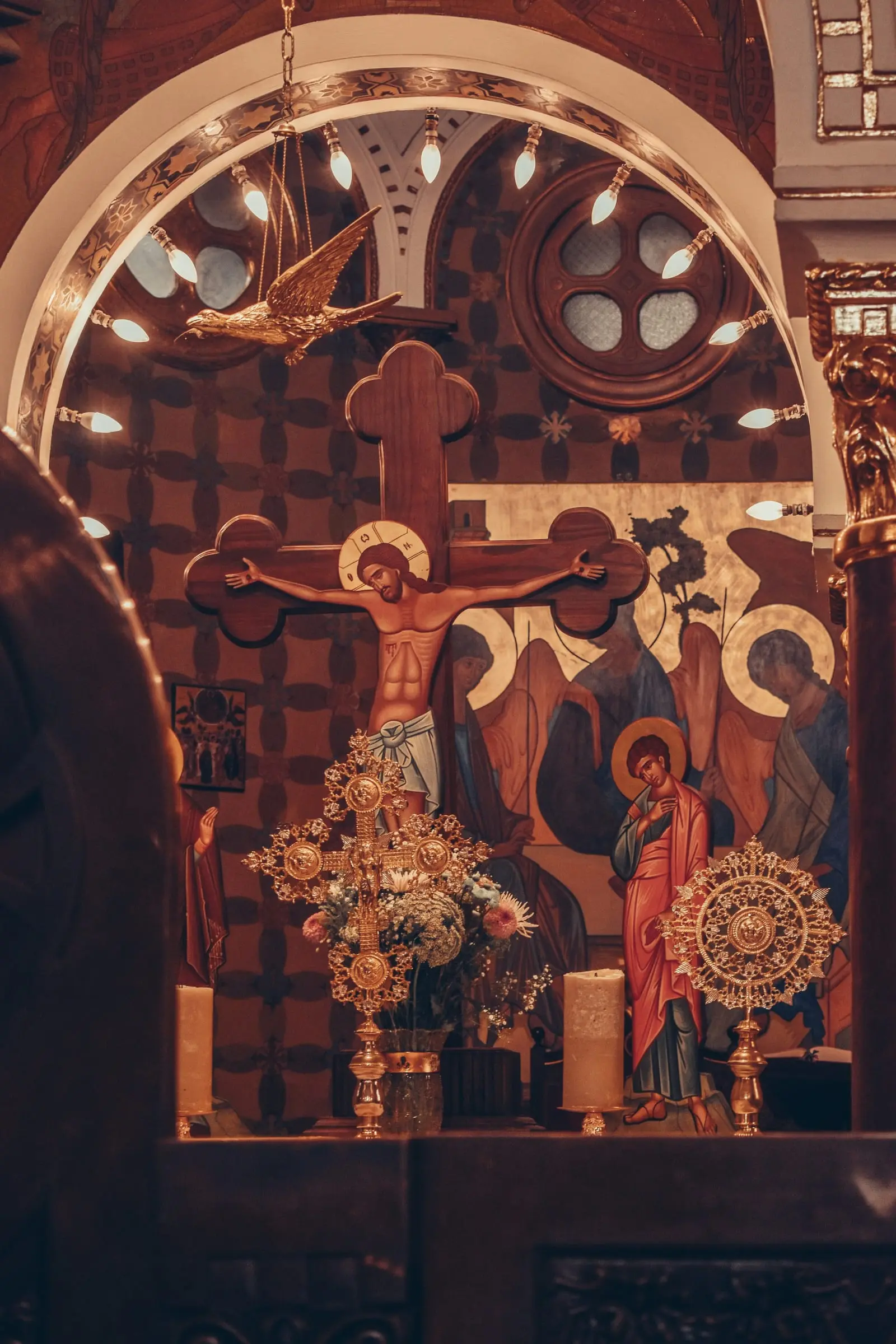
The Death of Man & Christ in the Garden of Eden
God is beyond every concept the human mind can frame, and yet the human mind was made to hold Him. Both halves of that sentence are true, and the Christian life is lived in the space between them. He exceeds all reasoning, and still He has given man the faculty of reason; He cannot be captured by thought, and still He commands to be thought upon, remembered, magnified, and loved. The highest thought a man can retain in his mind is God, and the best use of a human heart is to set its affection upon Him. To learn to do this is the first work of the soul, and it is the work most of us neglect.
My argument in these pages is that union with God begins in the mind, in the deliberate and trained contemplation of God, and that this contemplation is the means by which the whole man is healed. I shall also argue that the depth of the union God desires is disclosed most fully in the incarnation, and that the incarnation was not an afterthought. In the day Adam ate, God bound Himself to die with him. The remedy for the fall was planted in the garden before the fall occurred, for the tree of life in Eden was already, in figure, the cross of Christ. From this it follows that salvation is a real participation in the life of God, and that such participation is lived within the Church the apostles received and in the sacrament of the Lord's body and blood.
The essay moves in that order. It begins with the contemplative mind: what it is, why it is difficult, and why the Lord rebuked Martha and praised Mary. It then considers how God makes Himself known, through the revelation of the Holy Trinity and through the patriarchs and prophets who carried that revelation in partial form until Christ. It turns next to Malachi's remnant, who thought upon the name of the Lord and were written in a book of remembrance. From there it descends into the garden, to the command concerning the tree, to what Adam's death meant for God Himself, and to the tree of life that reappears in the closing chapter of the Bible. It ends with the consequences: a faith that works, a Church that is visible, and a table at which the faithful receive the life of the Lamb.
A man whose mind is empty of God will fill it with something else, and the something else will rule him. Worry will rule him, or fear, or the restless churning of thoughts that circle and never land. A Christian who never learns to contemplate God will find his prayers scattered, his worship divided, and his reading of his own circumstances governed by whatever he happens to see and feel. Contemplation is therefore the ground of sanity, and union with God is the only remedy for a mind that has been wounded by its own thoughts.
The Loftiest Thought
Contemplation as an Art
Contemplation is an art. It is a practice, an exercise of the mind and of the heart in which the affections are gathered and set upon God. Like every art it must be learned, and like every art it is learned slowly, through repetition, failure, and return. It is at once the loftiest exercise a man can undertake and the most difficult, because the object of contemplation exceeds the faculty that contemplates. God in His nature is beyond the conceptualisation of man. No idea encloses Him, no argument comprehends Him, and no image exhausts Him.
And yet He created us with the capacity to reason, and He chose to make Himself known through that capacity. God is perceived and understood through the LogosLogosThe eternal Word of God, through whom all things were made, who became flesh and dwelt among us (John 1:1–14)., a Greek term meaning word, reason, or rational utterance, which the Apostle John applies to the eternal Son. God has chosen to reveal Himself to His creation through His Word, and that Word addresses the reasoning mind. The incomprehensible has spoken in language; the One beyond reason has given reason something to receive. This is why the exercise of the mind toward God is not optional for the Christian. It is the posture God Himself has invited by speaking.
Contemplation serves two purposes, and both matter. It is a fortification, building walls in the mind against alien forces that would occupy it. It is also a medicine, the means by which a disordered mind is healed. A soldier stands watch to keep the enemy out; a physician tends the wound the enemy has already made. The mind that contemplates God is both guarded and restored, and it cannot be fully restored by any other means.
The Fool and the Oppressive Thought
The Psalmist names the opposite condition plainly: "The fool hath said in his heart, There is no God." (). Whatever his intelligence, the fool is a fool because God is absent from his mind and absent from his heart. Foolishness, in the biblical sense, is the absence of God in the inner man, and wickedness is the refusal to enthrone God there. Evil begins as an empty throne within, long before it becomes an act of the hands.
Consider how easily the mind retains thoughts of low substance. We ponder them, return to them, chew them over long after they have yielded anything of value. Some thoughts grow oppressive in their force and in their speed, until a man's mind, and then his life, begins to revolve around them. They arrive uninvited and remain unwelcome, and yet we give them hospitality for hours. Anyone who has lain awake rehearsing a fear knows the tyranny of a thought that will not leave.
This is why the Lord Jesus Christ instructed His disciples to take no thought: "Therefore I say unto you, Take no thought for your life, what ye shall eat, or what ye shall drink; nor yet for your body, what ye shall put on. Is not the life more than meat, and the body than raiment?" (). And again: "Take therefore no thought for the morrow: for the morrow shall take thought for the things of itself." (). Christ would not have legislated concerning thought if thought were harmless. He legislated because thoughts shape lives. We cannot, after reading these words, pretend that what we think about is a private matter without consequence.
The argument runs from the lesser to the greater. If worry, and the thoughts that breed worry, can disorder a man's peace, his health, and his decisions, then the contemplation of God must have a comparable effect in the opposite direction, and a greater one. A man cannot dwell upon the majesty of God, upon His goodness and His greatness, and remain untouched. Thoughts engender emotions. More than that, thoughts propose realities other than the one a man presently occupies. When you worry, you are living inside a reality that has no physical existence; you inhabit a tomorrow that has not arrived and may never arrive. If the mind can be carried into an imagined calamity, it can also be carried into the presence of the living God, and the effect upon the psyche, upon the being, and upon the whole life will be correspondingly real.
The One Thing Needful
Martha's Service and Mary's Seat
In Luke's Gospel the Lord comes to the house of Martha and Mary, the household at Bethany where Lazarus, whom He loved, also lived. Martha welcomed Him and set about preparing a meal, determined to serve Him as well as she could. The Lord of glory had entered her house, and she would do everything in her power to honour Him. Her sister did something else entirely: "And she had a sister called Mary, which also sat at Jesus' feet, and heard his word." (). Mary understood that Jesus had come to communicate something, and she attended to what He came to give.
Martha's agitation grew until it became resentment. "But Martha was cumbered about much serving, and came to him, and said, Lord, dost thou not care that my sister hath left me to serve alone? bid her therefore that she help me." (). She believed that welcoming the presence of God meant doing things for Him. Her devotion was performative; it expressed itself in activity, and it judged the stillness of her sister as idleness of no value or significance. Her envy could no longer be contained, and so she appealed to the Lord to correct Mary.
The Lord corrected Martha instead. "And Jesus answered and said unto her, Martha, Martha, thou art careful and troubled about many things: But one thing is needful: and Mary hath chosen that good part, which shall not be taken away from her." (). The one thing needful was the contemplation and reception of His Word, His Logos. Once the presence of God has been received, the next movement in entertaining that presence is contemplation, a waiting upon whatever proceeds from His mouth. Activity has its place, but it is a lesser place. The service that does not first sit at His feet becomes a burden, then a grievance, and finally an accusation against those who have chosen better.
The Word That Came
This is the very exercise through which God led Israel in the wilderness. "And thou shalt remember all the way which the LORD thy God led thee these forty years in the wilderness, to humble thee, and to prove thee, to know what was in thine heart, whether thou wouldest keep his commandments, or no. And he humbled thee, and suffered thee to hunger, and fed thee with manna, which thou knewest not, neither did thy fathers know; that he might make thee know that man doth not live by bread only, but by every word that proceedeth out of the mouth of the LORD doth man live." (). God permitted hunger in order to teach. Bread sustains the body for a day, but it does not sustain the life of man. Man lives by the Word, and there is therefore an essential necessity in receiving it and contemplating it.
The Scriptures make this concrete when they describe how God appeared to the patriarchs and prophets. Again and again we read that the word of the LORD came to a man. The phrase describes an encounter, for that Word was a personal manifestation of God. In the same way Genesis records that Adam and his wife "heard the voice of the LORD God walking in the garden in the cool of the day" (). A voice that walks is a Person. What walked in the garden was the Logos, the pre-incarnate Christ, God making Himself present to man through His Word.
The engagement of the mind with God, with the eternal substance, with the true Light and the true Life, is therefore essential for the restoration of the mind, the restoration of the soul, and the healing of the whole man. A man who does not retain God in his mind cannot expect to be healed by that same God. He cannot expect to be made whole by One he refuses to think upon. The mind is a faculty given by God to receive and to contemplate; it was made to turn toward the One who cannot be contained by contemplation, and to rest upon the eternal.
The Mind Made for the Unseen
Paul describes this turning in the midst of suffering: "For our light affliction, which is but for a moment, worketh for us a far more exceeding and eternal weight of glory; While we look not at the things which are seen, but at the things which are not seen: for the things which are seen are temporal; but the things which are not seen are eternal." (). The Apostle grants that affliction is real, yet he refuses it the final word, and he makes its outcome depend upon where the believer looks. Affliction works glory while we look at the unseen.
The effect of our afflictions upon us, then, is determined by our ability to see beyond what we see and to feel beyond what we feel. We may be wounded, and the wound may be genuine, but there is a higher dimension of reality upon which we can set our gaze and our considerations. When we do, what the body suffers is made to yield glory. The same pain, contemplated without God, embitters; contemplated in God, it ripens into weight.
When Scripture declares that man was created in the image of God, "So God created man in his own image, in the image of God created he him" (), the image is found above all in the mind. Man thinks, processes, analyses, and reasons, and these are faculties that bear the likeness of divinity. A dog cannot reason; a cat cannot reason. What distinguishes man from every other creature is that God has given him a mind fashioned after His own likeness. We think, and therefore we are capable of contemplating God; we remember, and therefore we are commanded to remember Him. "But thou shalt remember the LORD thy God" (). The command presupposes the faculty, and the faculty finds its purpose in the command.
Prayer as the Gathering of the Self
This bears directly upon prayer. Prayer is far more than a petition presented to God. It requires that a man master himself, that he collect his consciousness and gather his scattered faculties into one. James warns: "But let him ask in faith, nothing wavering. For he that wavereth is like a wave of the sea driven with the wind and tossed. For let not that man think that he shall receive any thing of the Lord. A double minded man is unstable in all his ways." (). The double minded man has two minds, two opinions, two directions of thought. Prayer, rightly understood, is the concentration of the whole man toward God.
God's complaint against Israel makes the same point from the other side. "This people draweth nigh unto me with their mouth, and honoureth me with their lips; but their heart is far from me." (, quoting ). God did not accept that worship because the worshippers were divided. Their lips were present and their hearts were absent, and their entire being was not committed to the act. God requires the whole of man, and He will not receive a fraction as though it were the offering.
It is fair, then, for each of us to take an honest inventory. In a single day, how much of God is retained in your mind? In twelve waking hours, how much of your attention is given to the contemplation of Him? There is spiritual value and spiritual consequence in the answer. The measure of God in our minds will become the measure of God in our lives.
The Revelation That Saves: The Trinity and the Temporal Icons
Magnifying the Lord
The Psalmist calls the faithful to "O magnify the LORD with me, and let us exalt his name together." (). To magnify God is to enlarge Him as far as it concerns us, in our perception and in our souls, for He Himself has no need to grow. Some people carry a conception of God so minuscule that it cannot survive a single crisis. The call to magnify is a call to let our perception of God expand toward the truth.
This is why true theology is revelational, and why it is relational. Theology in its proper sense is a revelation that leads to communion. No man can know God by study alone; God can be known only as He reveals Himself. Books may arrange what has been revealed, but they cannot reveal. A theology of books does not save, and it cannot save. Theology, properly so called, is the apokalypsis, the unveiling, of God to the heart of man.
The Trinity at the Centre
The summit of this revelation, what the Fathers regarded as the theology of the Christian life, is the Holy Trinity. If a man could take the mystery of the Trinity into his soul, he would come into perfection, because it is the revelation of the Trinity that raises man to the status for which God created him. The Trinity is the Magna Carta of Christian thought. Without it a man understands neither God, nor man, nor the purposes of God for man. There is no greater mystery than this: that God is one, and yet multi-personal.
When we speak of God, therefore, we speak of God the Trinity. We never speak of Him in merely monadic terms, although as God He is indeed one, a single undivided essence. He has chosen to reveal Himself to creation as Father, Son, and Holy Spirit, and true Christianity concerns itself with contemplating the reality in which God has chosen to make Himself known. The Church has fought throughout the ages to preserve this confession in the mind of the believer and in the mind of the Church, because it is this confession that saves. It explains the cosmos, it explains mankind, it explains the purposes of God for man, and it explains the destiny of man.
Some object that they cannot be Christians because they cannot understand a faith that seems to worship three gods, and they insist that God ought to reveal Himself in a way that makes sense to them. The proper answer is a question of standing: who are we to dictate to God how He will make Himself known? It is a mystery, and a mystery is a truth too large for the vessel that receives it.
Revelation Given in Measure
God reveals Himself in measure, and only as He chooses. He said to Moses: "And I appeared unto Abraham, unto Isaac, and unto Jacob, by the name of God Almighty, but by my name JEHOVAH was I not known to them." (). When He appeared to Abraham He was Jehovah all the same, and yet that revelation was withheld from Abraham. God can be known only through the revelation He communicates, and that revelation is the revelation of Himself.
That revelation is not subjective. Throughout the history of mankind God has used patriarchs and prophets as what I call temporal icons, living images in time through which a revelation of God is given and fixed. When God reveals Himself to Abraham, Abraham becomes the temporal icon of that revelation, the reference point through which God has made Himself known in that dispensation. No one in that age may step outside the mode of revelation God has communicated through Abraham. Then Moses comes, and he too becomes a temporal icon, and every revelation in turn points beyond itself to something still to come.
The Ram That Was Not the Lamb
Consider Moriah. God said to Abraham: "Take now thy son, thine only son Isaac, whom thou lovest, and get thee into the land of Moriah; and offer him there for a burnt offering upon one of the mountains which I will tell thee of." (). Abraham left the servants behind, and he and the boy climbed the mountain with the wood. Isaac asked the question that echoes through the whole of Scripture: "Behold the fire and the wood: but where is the lamb for a burnt offering? And Abraham said, My son, God will provide himself a lamb for a burnt offering" ().
What unfolds on that mountain is a temporal drama that is revelational in its purpose, a shadow and a type pointing elsewhere. Abraham binds the boy, and the boy does not fight or resist; he simply yields to his father. Abraham lifts the knife, and the angel of the LORD calls from heaven: "Lay not thine hand upon the lad, neither do thou any thing unto him: for now I know that thou fearest God, seeing thou hast not withheld thy son, thine only son from me." (). Then comes the detail that carries the whole meaning: "And Abraham lifted up his eyes, and looked, and behold behind him a ram caught in a thicket by his horns: and Abraham went and took the ram, and offered him up for a burnt offering in the stead of his son." ().
Abraham had said that God would provide a lamb, and God provided a ram. A ram and a lamb are different animals, and the difference is deliberate. The ram stands in place of Isaac, who was the true offering on that mountain, and its presence declares that the revelation is incomplete. The offering God would one day give for the world would be a Lamb. The ram is a placeholder for the icon; the icon that is coming is the Lamb, who is Christ, "the Lamb of God, which taketh away the sin of the world" (). Moriah shows us the archetype unfinished, awaiting its fulfilment generations later.
Moses, David, and the One Whom They Pierced
When God revealed Himself to Moses by the name Jehovah, Moses became the temporal icon of that revelation, the reference for an entire nation's knowledge of who God is. Yet the scope of that revelation was limited, and Moses himself said so. God promised: "I will raise them up a Prophet from among their brethren, like unto thee, and will put my words in his mouth; and he shall speak unto them all that I shall command him. And it shall come to pass, that whosoever will not hearken unto my words which he shall speak in my name, I will require it of him." (). Peter, preaching in Jerusalem, sharpened the warning: "every soul, which will not hear that prophet, shall be destroyed from among the people." ().
By announcing another prophet like himself, and with him another lawgiver, Moses was foreshadowing that his own law was not sufficient. He was prophesying a change of priesthood yet to come. David is the same: a king who carries a revelation of God's rule, and who points beyond his own throne. All these figures are hosts and placeholders of God's revelation across the ages, until the One whom they pierced takes flesh. "They shall look upon me whom they have pierced" ().
This One is the totality of all the revelations given to every generation, because He does not merely carry a revelation of God. He is God. He is, in Paul's words, "the image of the invisible God, the firstborn of every creature" (), the One in whom the invisible becomes visible. Every temporal icon was partial; He alone is complete. The patriarchs held the revelation the way a lamp holds light, while Christ is Himself the Light.
Those That Thought upon His Name
The Book of Remembrance
Malachi records a scene that belongs at the heart of any account of the contemplative life. "Then they that feared the LORD spake often one to another: and the LORD hearkened, and heard it, and a book of remembrance was written before him for them that feared the LORD, and that thought upon his name. And they shall be mine, saith the LORD of hosts, in that day when I make up my jewels; and I will spare them, as a man spareth his own son that serveth him. Then shall ye return, and discern between the righteous and the wicked, between him that serveth God and him that serveth him not." ().
The Hebrew behind spake carries the sense of setting words in order, and therefore of arranging the mind before the tongue moves; it means to declare, to speak on behalf of, to think and to tell. Other translations render the verse in terms of thinking as much as speaking. The phrase thought upon his name translates a verb that means to reckon, to weigh, to esteem. These were people whose minds were arranged around God, and whose conversation flowed from that arrangement.
The LORD hearkened, and the sense is better rendered that He attended. He was the subject of their discourse, and because He was their subject, He was present. Their speech about Him became an invitation to Him. This sheds light on the Lord's promise: "For where two or three are gathered together in my name, there am I in the midst of them." (). The promise certainly applies to a gathering of persons, but it also has an interior application. Man is a tripartite being, spirit, soul, and body, as Paul prays that "your whole spirit and soul and body be preserved blameless" (). When the internal man is gathered, when mind, heart, and body are collected into one in His name, that gathering also brings the presence.
A book of remembrance was written before him and for them, for those who feared the LORD and thought upon His name. What follows is the language of possession: They shall be mine. It is the language of treasure: when I make up my jewels. It is the language of preservation: I will spare them, as a man spareth his own son. The identifying mark of those who serve the Lord is that they think upon His name. Contemplation would have no value if it did not cause the Lord to attend, to hear, and to write; but it does all three, and on that basis He discerns between the one who serves Him and the one who does not.
The Interior Operation
One of the marks of true service, then, is the retention of God in the mind, the contemplation of His name. Religion is more than an outward act. There is an entire interior operation that a man must learn to master in his relation with God. The Scriptures summon us to draw near with the heart: "Let us draw near with a true heart in full assurance of faith" (). A man can be physically close and inwardly far, very far, from God. Your thoughts of God matter.
For this reason there is constant warfare in the mind over the rightful place of God there. Satan's strategy is to govern our perception of God through the interpretation of our external conditions. He teaches us to measure and weigh God by what we experience, so that a good week means a good God and a hard week means an absent one. This method is false, because God is outside the realms of physicality and beyond every material conception. To engage Him truly, a man must come out of the material world, detaching his mind from it even while his body remains.
This is the plain teaching of Scripture. "If ye then be risen with Christ, seek those things which are above, where Christ sitteth on the right hand of God. Set your affection on things above, not on things on the earth." (). The command assumes that the mind can do this, that it possesses a capacity to ascend into the immaterial world even while the body remains on earth.
The Ascent of the Mind
Paul gives an example of that ascent. "I knew a man in Christ above fourteen years ago, (whether in the body, I cannot tell; or whether out of the body, I cannot tell: God knoweth;) such an one caught up to the third heaven. And I knew such a man, (whether in the body, or out of the body, I cannot tell: God knoweth;) How that he was caught up into paradise, and heard unspeakable words, which it is not lawful for a man to utter." (). Here is a man, and yet he is caught up into paradise in a manner independent of his body. The mind can engage the immaterial because it is itself of immaterial substance. Only the body was formed from the dust of the ground.
The use of the mind in contemplating God is therefore essential for the healing of the entire being. The only way to have a right mind in this life is to have a mind with God, a mind that has God in it. Health of mind is inseparable from the presence of God in the mind.
The Folly of Expelling God
Return to the fool. He has said there is no God, and in saying it he has expelled God from his heart and from his mind. Where, then, does he derive his meaning? If there is no God, there is no sufficient meaning for his existence. He is a contingent being; he did not exist by his own volition, nor did he will himself into being. It was willed that he should exist. There must therefore be a sufficient meaning outside that contingent creature from which he derives his meaning, and he cannot supply it to himself.
When God is expelled, the result is nihilism, hopelessness, and emptiness, and what the fool calls freedom is enslavement. The demons who persuaded him that there is no God know better themselves: "Thou believest that there is one God; thou doest well: the devils also believe, and tremble." (). They cannot deny their contingency upon God, because they exist by Him. Without God the Word, nothing could live and nothing could exist: "All things were made by him; and without him was not any thing made that was made." (). Everything owes its existence to Him.
That man has the agency to deny God and to expel Him from the mind proves that man has free will. God has done everything He can to keep the reality and testimony of Himself present in creation, even within the heart of man. The fool must work against the evidence of his own existence in order to remain a fool. Contemplation of God can never be relegated to a meaningless exercise, for it carries spiritual significance and spiritual consequence.
Binding the Strong Man
All of this has a practical edge for anyone passing through a hard season. The thoughts that seek to destroy you cannot simply be wished away. They must be expelled, and to expel them you must bring in a stronger impulse of thought, a greater force than the one that has taken residence. The Lord said: "No man can enter into a strong man's house, and spoil his goods, except he will first bind the strong man; and then he will spoil his house." (). In the mind, those oppressive thoughts are strong men occupying the house.
You bind them by inviting God into the mind. "Let God arise, let his enemies be scattered: let them also that hate him flee before him." (). This is how every destructive thought is dispelled: by the imposition of God upon it. The contemplative fights, and his weapon is the presence of God enthroned where the enemy once sat.
In the Day Thou Eatest: The Fall and the Godhead
The Chief End of Man
In the first essay of this series on union with God I argued that God must become the primary focus and the primary object of a man's pursuit. True peace in this world comes from understanding that God is "Alpha and Omega, the beginning and the end, the first and the last" (), and that our greatest need is Him who lives for ever. There are not two ways about it. "But seek ye first the kingdom of God, and his righteousness; and all these things shall be added unto you." (). We commit ourselves to the kingdom, to the reign and dominion of God, and to His righteousness.
A deficiency of what we need does not come from God. It comes from our own failure to pursue Him first, for God is never against us; He is always for us. We must adopt the right mindset about what we do and how we do it, and God must stand at the centre of our affections and pursuits. There we find life, fulfilment, and purpose. Union with God is the chief duty of man, and it is in the light of this union that I return to the garden, a passage often read but rarely read for what it says about God Himself.
The Command in the Garden
"And the LORD God took the man, and put him into the garden of Eden to dress it and to keep it. And the LORD God commanded the man, saying, Of every tree of the garden thou mayest freely eat: But of the tree of the knowledge of good and evil, thou shalt not eat of it: for in the day that thou eatest thereof thou shalt surely die." ().
Every element of the arrangement comes from God. God placed the man in the garden. God gave him his assignment. God gave the instruction. God planted both trees. God granted the freedom to eat of every tree, and God set the limit. The tree itself did not contain death, because God, who planted it, does not plant death. What brought death was disobedience to the commandment of God.
Disobedience introduces temporality into man. It cuts the circuit of his life short and shortens his days. Disobedience is destructive because it is separation from the One who is Life. It cuts the creature off from its source. The tree was the occasion; the rebellion was the cause.
When Adam Died, God Bound Himself to Die
There is a further revelation embedded in God's warning. In the day that thou eatest thereof thou shalt surely die carries a second meaning: in the day Adam eats, both Adam and God will die. Adam's death is what makes the incarnation necessary. In the day you die, I will die. The disobedience of Adam did not affect Adam alone; it reached the very Godhead that constituted him.
Before the fall, within the life of the Holy Trinity, there was only one nature, the uncreated nature of God. The three Persons, Father, Son, and Holy Spirit, share one eternal essence. The Father is not the Son, the Son is not the Spirit, and the Spirit is not the Father; all three are God, and they are not one another. When Adam died, he made it necessary for one Person of the Godhead to take on a second nature, a created human nature, which would henceforth be united to the divine nature in that Person. The consequences of Adam's disobedience extended into the composition of the Trinity's life with creation, for the Son would now be forever God and man.
It was necessary because there was no other man. When Adam sinned, he was the first and only man. Salvation could not come from any man before him, for there was none, or from any man after him, for every man after him would come from him and share his condition. Adam could not redeem himself, and there was no one in the garden to redeem him: no other man created perfect and sinless who could stand in his place after he fell. The entire human race was subjected to eternal death and eternal separation from God.
The Second Death and the Second Adam
Scripture speaks of a first death and a second. "Blessed and holy is he that hath part in the first resurrection: on such the second death hath no power" (). The second death is the lake of fire, eternal separation from God: "And death and hell were cast into the lake of fire. This is the second death." (). Death's final residence is the lake of fire, and those who do not rise to life fall to it.
If we read as it stands, then once the first man sins, no second Adam can arise by nature from the first. Whoever the second Adam would be, He would have to be the Lord Himself. Paul articulates this precisely: "And so it is written, The first man Adam was made a living soul; the last Adam was made a quickening spirit. Howbeit that was not first which is spiritual, but that which is natural; and afterward that which is spiritual. The first man is of the earth, earthy: the second man is the Lord from heaven." (). The last Adam, the quickening Spirit, can only be God, because after Adam's sin there was no man before or after him who could render the justice required for the treason he had committed.
When God said, Thou shalt surely die, He also meant, I shall die. The death of man reached into the Godhead from which man was constituted. And the healing of the race was already provided in the garden, as I shall show below. What is healthy needs no healing; only what is deficient does. As the Lord Himself said, it is the sick who need a physician, not the whole. If God made provision for healing and redemption in Eden before Adam ever sinned, then the death Adam incurred was always going to be met by a God who would share it.
Against a Merely Forensic Salvation
This brings me to a conviction I hold firmly. There is an ancient rule, expressed by the Fathers: what the Son did not assume, He did not heal. He cannot save what He has not taken to Himself. For this reason I reject the Protestant account of salvation as primarily forensic, that is, as a legal declaration in which God pronounces the sinner righteous without that pronouncement being grounded in a real change of nature. Salvation cannot be forensic in its essence when the God who instituted it became incarnate, took a nature other than His own, in order to save the man who had fallen.
If all that was needed was a pronouncement, He should simply have pronounced. He need not have undergone the labour of becoming man in order to save men if all that was required was to say, You are not guilty. God is almighty. "For when God made promise to Abraham, because he could swear by no greater, he sware by himself" (). A God who can swear by Himself to keep a promise could just as easily have declared the race saved by fiat. He could have said over fallen Adam, Let us undo it and begin again, as He once said, Let there be, and it was.
He did not, and the fact that He did not is decisive. The assumption of His creature's properties was pivotal. If salvation consists in nothing more than profession, then the incarnation is left unexplained, and the doctrine collapses into a folly of logic. Its epistemology is wrong, because it begins with man and what man must do, instead of beginning with God and what God has done. The moment we begin with what God did, salvation can no longer be reduced to a juridical transaction.
God did more than confer a status. "For he hath made him to be sin for us, who knew no sin; that we might be made the righteousness of God in him." (). We are made, not merely called, righteous. In the same way that He took up the properties of the creature in order to save it, He grants the creature grace to take on the properties of His divinity: "Whereby are given unto us exceeding great and precious promises: that by these ye might be partakers of the divine nature" (). Salvation is participatory. It is relational. Without this, we have no real relationship with God and no communion with Him, only legal standing on the basis of legalities.
The Tree of Life and the Cross
One Throne, One River
I claimed above that the healing of mankind was already present in the garden. The proof lies at the other end of the Bible. "And he shewed me a pure river of water of life, clear as crystal, proceeding out of the throne of God and of the Lamb. In the midst of the street of it, and on either side of the river, was there the tree of life, which bare twelve manner of fruits, and yielded her fruit every month: and the leaves of the tree were for the healing of the nations." ().
The river proceeds out of the throne, singular: one throne, and that one throne belongs to God and to the Lamb. Here the Son bears His new name. Before the incarnation He is known as the eternal Logos; after His death, resurrection, and glorification He is the Lamb, and the name is a memorial of what He did. God sits upon the throne, and the throne belongs also to the Lamb. God is God, and the Lamb is God; the two are one, and yet they are not the same Person. The Father is God and the Son is God; they are distinct Persons, and they share one throne.
The Same Tree in Eden and in the New Jerusalem
The arrangement is precise: the throne is the fountainhead, the river flows from the throne, and on either side of the river stands the tree of life. Now apply the laws of logic to Eden. There was a tree of life in the garden, "the tree of life also in the midst of the garden" (), and there was a river, "And a river went out of Eden to water the garden" (). A throne is not mentioned, but it must have been there, because this is the order of the flow. Garden, river, tree; therefore also throne.
If the tree John describes is the same tree Moses describes, then the properties of the tree in Revelation must apply to the tree in Genesis. That is consistency of logic, and it is consistency of scriptural reasoning. It bears twelve manner of fruits; this must be true of Eden's tree too. It yields fruit every month; this must be true as well, for God said that of every tree of the garden man might freely eat, so the tree of life was edible and bore fruit. And its leaves are for the healing of the nations; this, too, must apply to the tree in Eden.
Healing Before the Wound
Here is the difficulty that unlocks the passage. The trees of Eden were planted before man was formed; that is a theological fact Genesis establishes. If the tree of life bore leaves for the healing of the nations, what healing was needed? The word is ethnos, nations, peoples, multitudes. There were no nations in the garden, no multitudes, no peoples requiring healing. Yet the provision for their healing was already growing.
The tree also stands on either side of the river, one tree on both banks. John seems to describe one tree in nature, called the tree of life, which is nevertheless many trees: one homoousios, one shared essence, and twelve hypostases, twelve distinct subsistences, bearing twelve manner of fruits. Six on this side and six on that. The number twelve runs through the whole design of God. There are twelve tribes of Israel. There are four and twenty elders seated about the throne (), twelve on either side. There are twelve apostles of the Lamb. The tree of life bears twelve manner of fruit.
Paul names the tree whose leaves heal the nations. "For Christ sent me not to baptize, but to preach the gospel: not with wisdom of words, lest the cross of Christ should be made of none effect. For the preaching of the cross is to them that perish foolishness; but unto us which are saved it is the power of God." (). The cross has an effect, and that effect is the power of God unto salvation. Archetypally, the tree of life is the cross of Christ, for from that tree all redemption flows and all healing flows.
If Christ does not die, man cannot be saved. If Christ does not die, man cannot be healed. If Christ does not die, man is lost forever, death cannot be absorbed, and sin cannot be judged. As early as the first days of man, the revelation of Christ was kept in the garden. The tree of life is Christ Himself, but He cannot give life to the world until He gives His life. Christ must truly die for the world to have life. When He said, "I am come that they might have life, and that they might have it more abundantly" (), the life He spoke of was His own. He came to give us His life through His death on the cross, and the fruits of that tree are beyond counting. God had a provision for Adam before Adam needed one.
The Way Barred to Save the Man
God gave man access to the tree of life from the beginning. After the disobedience, He blocked the way. "And the LORD God said, Behold, the man is become as one of us, to know good and evil: and now, lest he put forth his hand, and take also of the tree of life, and eat, and live for ever: Therefore the LORD God sent him forth from the garden of Eden, to till the ground from whence he was taken. So he drove out the man; and he placed at the east of the garden of Eden Cherubims, and a flaming sword which turned every way, to keep the way of the tree of life." ().
The barring of the way was itself an act of salvation. The tree of life imparted immortality. Had Adam eaten of it before he ate of the tree of the knowledge of good and evil, immortality would have been conferred upon him. God has no objection to man living for ever. His objection is to man living for ever in a state of sin. To eat of the tree of life after the fall would have sealed man in his ruin; the flaming sword kept him from an eternity of death disguised as life.
Why Man and Not the Angels
Adam was not the first creature to commit treason. He was the first creature to commit treason for which God became incarnate and set a redemptive process in motion. Other celestial beings had rebelled before him: "And the angels which kept not their first estate, but left their own habitation, he hath reserved in everlasting chains under darkness unto the judgment of the great day." (Jude 6). For them God established no plan of redemption, only judgment. When man sinned, God set in motion a work that culminates in God Himself becoming what He had made, in order to save it. The question presses itself upon any reader of Scripture: why does God save man and not the angels?
The answer lies in the words of : the man is become as one of us, to know good and evil. Man did not become like God in nature. He became like God in knowledge. If the tree of life imparts life, the tree of the knowledge of good and evil imparts knowledge, and the biblical word for knowing implies intimate contact. When Adam ate, he came into intimate contact with the knowledge of a good nature and an evil nature. The name of the tree also reveals that evil already existed in the universe, for the tree God planted was the tree of the knowledge of good and evil. Had Adam come into contact only with the knowledge of good, it would have been well. But he came into contact with the knowledge of evil, and that knowledge corrupted him, because he did not yet possess the developed faculties to sustain, contain, and handle such knowledge without being changed by it.
The angels are another matter. We know of Satan, of Lucifer, of the fallen angels and of those bound in the great river Euphrates (). They are not saved because of their nature. They already possessed, by creation, an unending existence; they fell as spirits, in a nature unlike man's. By their very constitution they became unredeemable when they fell. They were created as sons of God with a deathless nature, already partaking in that immortal mode of being which man was meant to receive only as a gift. This shows that disobedience and rebellion carry real consequences, and that those consequences are not merely forensic or legal. They are ontological, affecting the very nature of things.
Satan and his hosts were already living for ever when they fell, so there was no temporality in their nature to be redeemed. Man was of another substance. Human nature is a created essence distinct from the Creator's, and because it does not possess divine nature, God could assume it, and man is therefore savable on that account. If man had been of the substance of the angels, man too would have been beyond salvation. The fallen angels do not die when they sin. Men die, because man has fallen short and disobeyed God.
Immortality as Gift
It follows that Adam was not created with eternal life inherent in his nature. There was a tree, a substance external to him, that would confer it. If he had been created with eternal life, he would not have needed the tree. Temporality was therefore assigned to his existence by creation itself, prior to any question of obedience or disobedience. He would have lived long, but long life is not immortality; immortality, signified by the presence of the tree, was always a gift of God. "For the wages of sin is death; but the gift of God is eternal life through Jesus Christ our Lord." ().
That gift was always reserved for mankind. When the Gospel of John speaks of eternal life, "For God so loved the world, that he gave his only begotten Son, that whosoever believeth in him should not perish, but have everlasting life" (), and when John writes, "And this is the record, that God hath given to us eternal life, and this life is in his Son" (), the thread reaches back to Genesis. God would not have said, Thou shalt surely die, if man could not die. Eternal life makes man immortal and impervious to death; the warning proves Adam did not yet possess it.
How long Adam would have lived, no one knows. The first men lived close to a thousand years, though none reached it; Methuselah, the oldest, lived nine hundred sixty and nine years (). Yet Scripture promises that the saints "shall reign with him a thousand years" (), and that after this God will make all things new and dwell with men for eternity on a renewed earth. None of this is possible unless He gives eternal life, and He gives it in His Son. The more we contemplate the place of the incarnation in the relationship between God and man, the more we see how much depends upon understanding it truly.
A Participating Faith in an Apostolic Church
The Lamb Foreordained
Peter brings together the holiness God demands, the judgment He exercises, and the eternal purpose He has fulfilled in Christ. "Because it is written, Be ye holy; for I am holy. And if ye call on the Father, who without respect of persons judgeth according to every man's work, pass the time of your sojourning here in fear: Forasmuch as ye know that ye were not redeemed with corruptible things, as silver and gold, from your vain conversation received by tradition from your fathers; But with the precious blood of Christ, as of a lamb without blemish and without spot: Who verily was foreordained before the foundation of the world, but was manifest in these last times for you, Who by him do believe in God, that raised him up from the dead, and gave him glory; that your faith and hope might be in God." ().
Two truths stand side by side here. The first concerns the Lamb. The word foreordained rests on the Greek proginōskō, to know beforehand. In context it speaks of the precious blood of Christ, the incorruptible substance by which we were redeemed. Before the world was made, before Adam was formed, before the foundations of the universe were laid, it was known to God that He would become incarnate for the sake of the creature called man. There is nothing accidental in the redemptive operations of God. His foreknowledge means that He knows every choice every creature will ever make, and He has provided for every one. The solution was the manifestation of the Son of God in creation.
Judged According to Works
The second truth concerns us. The Father judgeth according to every man's work. Peter does not say that God judges according to every man's faith. If the work of salvation required God to work, man must also do a work. The work man does is obviously not the same as the work God does. Nothing man could do could satisfy the demands of justice; the incarnation of Christ alone has accomplished salvation for mankind, and I do not diminish its exclusivity in the slightest. But we dare not say that nothing must be done.
Protestant thinking errs when it supposes that any work required of man disqualifies salvation, as though a man who must do anything were not truly saved. A salvation involving works means instead that we receive God's offer of salvation on His merits, and that the works we then do are those He commands. "He that believeth and is baptized shall be saved" (). Live a holy life. These are works, and if certain works are not done, God does not accept the man; if other works are done, God judges him.
Scripture is full of the evidence. Paul writes of "Hymenaeus and Alexander; whom I have delivered unto Satan, that they may learn not to blaspheme" (); Hymenaeus was among those who overthrew the faith of some by teaching error concerning the resurrection. It was their works, their resistance to the gospel, that brought judgment. In Corinth some ate the bread and drank the cup to their own damnation: "For he that eateth and drinketh unworthily, eateth and drinketh damnation to himself, not discerning the Lord's body." (). They called themselves Christians and partook of the sacrament, and yet something they failed to do brought condemnation.
Paul warns of those who "were once enlightened, and have tasted of the heavenly gift" and then fall away, that it is impossible "to renew them again unto repentance" (), and that for the one who sins wilfully after receiving the knowledge of the truth "there remaineth no more sacrifice for sins" (). Peter writes: "For it had been better for them not to have known the way of righteousness, than, after they have known it, to turn from the holy commandment delivered unto them." (). These words cannot be reconciled with faith alone. James is explicit: "Ye see then how that by works a man is justified, and not by faith only." (). Scripture itself refuses the formula, and it has no consistent witness in the history of the Church.
Faith is part of salvation, but not the whole of it. If it were the whole, Scripture would say that God judges every man according to his faith, and rewards him according to his faith. It says otherwise: "For we must all appear before the judgment seat of Christ; that every one may receive the things done in his body, according to that he hath done, whether it be good or bad." (). At the bēma, the judgment seat, some receive reward and some suffer loss: "If any man's work abide which he hath built thereupon, he shall receive a reward. If any man's work shall be burned, he shall suffer loss" (). If faith alone settled everything, there would be no need for repentance. Yet to five of the seven churches in Revelation the Lord says, in effect, Repent, or else: "repent, and do the first works; or else I will come unto thee quickly" (). A warning without consequence is no warning.
The Fullness of the Blessing
This understanding is vital because it compels those who believe to pursue. Paul speaks of coming "in the fulness of the blessing of the gospel of Christ" (), and that fullness is union with God. It is knowing God, and being known: "For now we see through a glass, darkly; but then face to face: now I know in part; but then shall I know even as also I am known." (). It is the passage from "ye cannot bear them now" () to the promise that the Spirit "shall teach you all things, and bring all things to your remembrance" (). And it rests upon the resurrection: "And if Christ be not raised, your faith is vain; ye are yet in your sins." ().
Christianity is ontological. It demands participation, and it demands synergy, the cooperation of human freedom with divine grace. It requires the manifestation of God's grace, and it equally requires a subject upon whom that grace is bestowed, and that subject is you and me. If we do not learn the participatory modes of Christianity, we shall find ourselves outside the Church.
The Church That Can Bind
The Lord Himself described the Church in terms no invisible fellowship could satisfy. "Moreover if thy brother shall trespass against thee, go and tell him his fault between thee and him alone: if he shall hear thee, thou hast gained thy brother. But if he will not hear thee, then take with thee one or two more, that in the mouth of two or three witnesses every word may be established. And if he shall neglect to hear them, tell it unto the church: but if he neglect to hear the church, let him be unto thee as an heathen man and a publican." ().
There are levels here, and each is concrete. Your brother is a real person. The two or three witnesses are real people. The Church to which the matter is finally brought is a real institutional body able to deal with such matters, and it holds the power to excommunicate the brother who refuses to make peace. It is the last court; beyond it there is only exclusion. If the Church has authority to banish, to excommunicate, and to revoke the standing of a Christian, how can it be invisible?
Those who say they belong only to a universal invisible community must answer a practical question. Where do they take their disputes? Suppose you read a passage of Scripture and reach one interpretation, and your pastor reaches another. God did not give the Scriptures to be interpreted a thousand different ways. Where then is the matter resolved, if the Church is an invisible force to which we are connected only by faith? Saint Ignatius of Antioch answered that wherever the bishop appears, there the people should be, just as wherever Jesus Christ is, there is the Catholic Church, catholic meaning universal. The Church of Christ is found where the episcopate is.
Sent as He Was Sent
The Lord said to the apostles: "as my Father hath sent me, even so send I you." (). And again: "He that receiveth you receiveth me, and he that receiveth me receiveth him that sent me. He that receiveth a prophet in the name of a prophet shall receive a prophet's reward" (). Were the twelve sent in the same manner as Jesus was sent by the Father? If the answer is yes, then they held authority in the same sense in which Christ held authority, and He sent them in that authority: Go ye therefore. On earth the authority of the apostles was essential, and it remains essential.
Some dismiss Peter, or Matthias, who was numbered with the eleven (). Yet consider the New Jerusalem: "And the wall of the city had twelve foundations, and in them the names of the twelve apostles of the Lamb." (). Your name is not inscribed upon the foundations of the city of the living God, and neither is mine. A man may give little credence to Peter, but Christ gives him a great deal, for He inscribes his name in the foundation of the city that comes down from God out of heaven. One cannot move away from the Christianity of the apostles and still call oneself a Christian in the full sense. Jesus did not send Martin Luther.
Jude exhorts us to "earnestly contend for the faith which was once delivered unto the saints" (Jude 3). We must fight for that faith, and we must fight to live it. Consider the alternative honestly: any one of us could wake tomorrow, declare himself a pastor or a leader, claim a vision from God, and start his own work. Nothing in an invisible church could stop him. That is a dangerous condition. We must be advocates of the truth even when the truth opposes our apparent reality, and accept the truth because it is the truth. Only then does true freedom come, and true life with it.
The Table of Union
The union with God that begins in contemplation and rests upon the incarnation is given its most concrete form at the table of the Lord. "For as often as ye eat this bread, and drink this cup, ye do shew the Lord's death till he come." (). In the Eucharist we portray and represent the Lord's death, offering to the Father the sacrifice that no man could have offered. From Adam until God became incarnate, no man could offer it. Only One could, He "whose goings forth have been from of old, from everlasting" (), the Logos, our Saviour, who became man in order to save us, heal us, and redeem us back to God.
We confess the true living presence of Christ in the Eucharist, His flesh and His blood, and we discern the Lord's body. "Take, eat; this is my body." And of the cup: "Drink ye all of it; For this is my blood of the new testament, which is shed for many for the remission of sins." (). When the crowd asked, "How can this man give us his flesh to eat?" (), He did not soften His words: "For my flesh is meat indeed, and my blood is drink indeed." (). Paul asks: "The cup of blessing which we bless, is it not the communion of the blood of Christ? The bread which we break, is it not the communion of the body of Christ?" (). At this table we drink the life in the blood of the eternal covenant, the life of immortality once guarded by the flaming sword and now given freely through the tree of the cross. The life promised in His blood flows into those who receive it, and the sacrifice of His body brings healing and wholeness.
Union with God reaches even into what we possess. When the faithful bring their offerings, they follow Jacob, who vowed, "of all that thou shalt give me I will surely give the tenth unto thee" (). They trust that "God is able to make all grace abound toward you; that ye, always having all sufficiency in all things, may abound to every good work" (). They look to the God who promised to rebuke the devourer and open the windows of heaven (), who says, "I will call for the corn, and will increase it" (), and who "giveth thee power to get wealth" (). They remember the widow of Zarephath, whose "barrel of meal wasted not, neither did the cruse of oil fail" () until the famine passed. They do not look east or west or south, "For promotion cometh neither from the east, nor from the west, nor from the south" (); their help comes from the LORD, who made heaven and earth. The God who entered the house of Martha and Mary desires to occupy every room of a man's life.
Conclusion
The path of this essay has run from the inner chamber of the mind to the throne of God and of the Lamb, and it has been a single road throughout. God is beyond all conception, yet He made the mind for Himself and spoke to it through His Word. The fool empties that mind of God and is ruled by lesser thoughts; Martha fills her house with service and loses the one thing needful; Mary sits at His feet and receives what cannot be taken from her. Malachi's remnant think upon His name, and God attends, writes, claims them as His jewels, and spares them. Contemplation is the means by which the whole man is gathered, guarded, and healed.
The same God who asks to be thought upon has shown how far He will go to be united with what He made. In the day Adam ate, God bound Himself to share his death. There was no other man to stand in Adam's place, and so the Lord from heaven became the last Adam, taking a created nature to Himself, because what He did not assume He could not heal. The provision was already planted in Eden: a tree of life with leaves for the healing of nations that did not yet exist, the same tree John saw beside the river flowing from the one throne. That tree is the cross. The Lamb was foreknown before the foundation of the world, and the ram on Moriah, the law of Moses, and the throne of David all pointed toward Him until He came.
The implications are pastoral, ecclesial, and eschatological at once. Pastorally, the believer in affliction must learn to bind the strong man by enthroning God in the mind, and to look at the things which are not seen until his suffering yields glory. Ecclesially, a salvation that is participation in God is lived within the visible Church the apostles received, under its authority and at its altar, where the body and blood of the Lord are given for the life of the world. Eschatologically, the immortality Adam forfeited is restored in the Son, and those who receive it will reign with Him and dwell with God in the new creation, eating of the tree whose way was once barred by a flaming sword.
Union with God begins where Mary sat: in a mind turned toward Him, attending to His Word. It is completed where John stood: before the one throne of God and of the Lamb, beside the river of life, under the leaves that heal the nations. Between the two lies the cross, the tree God planted before the first man drew breath, so that when man died, God would die with him, and so that man might live with God for ever.