The Enochian Order: Christ as the Initiator and Educator of Mankind into Theosis
Click to Download Edited Audio Transcript
Enoch B Mnisi, DD
The Christian Faith
At its heart, the Christian faith is not merely a system of moral piety but a profound initiatory path toward theosisTheōsisNot that we become God by nature, but that by grace we are drawn into His life: “partakers of the divine nature” (2 Peter 1:4). — the deification, or conformation, of humanity to the divine image. This transformative journey, which Scripture describes simply as "walking with God," finds its primordial archetype in the mysterious patriarch Enoch and its ultimate fulfillment in the person of Jesus Christ, the Incarnate LogosLogosThe eternal Word of God, through whom all things were made, who became flesh and dwelt among us (John 1:1–14).. It is in Christ that the possibility of divine communion — and the ontological transfiguration it entails — ceases to be a rare exception and becomes the central, realized promise of the Gospel.
This essay charts the theological contours of that transformative reality. It begins with the foundational principle of God's incarnational mode of revelation, which reaches its summit in the person of Christ. From there, it establishes Christ's exclusive role as the God-man (Theanthropos) — the sole mediator, temple, and teacher for humanity. It then turns to the ontological pursuit of immortality that defines the faith's highest aspiration, before examining the figure of Enoch as a pre-Incarnation paradigm for achieving deathlessness through communion with the eternal Logos. Finally, it connects that ancient pattern to the sacramental and spiritual life of the contemporary believer, showing how the Church's life in Christ is the Enochian Order brought to perfection.
To grasp this "Enochian Order" is to understand the Christian faith in its full depth. It is to see the faith not as a collection of historical beliefs to be affirmed, but as a living, divinely initiated order for transcending corruption and partaking in the very life of God.
Incarnational Principles: God's Modality of Revelation
To comprehend the Christian mystery, one must first grasp its foundational premise: the incarnational principle. This is the consistent modality by which God chooses to reveal spiritual reality through the medium of the physical and material. From the created order to the Holy Scriptures, God educates humanity through tangible things — a methodology that finds its perfect and final expression in the Incarnation of the eternal Logos, Jesus Christ. This principle establishes the interpretive framework through which all divine-human interaction occurs.
Creation and Scripture as Foundational Symbols
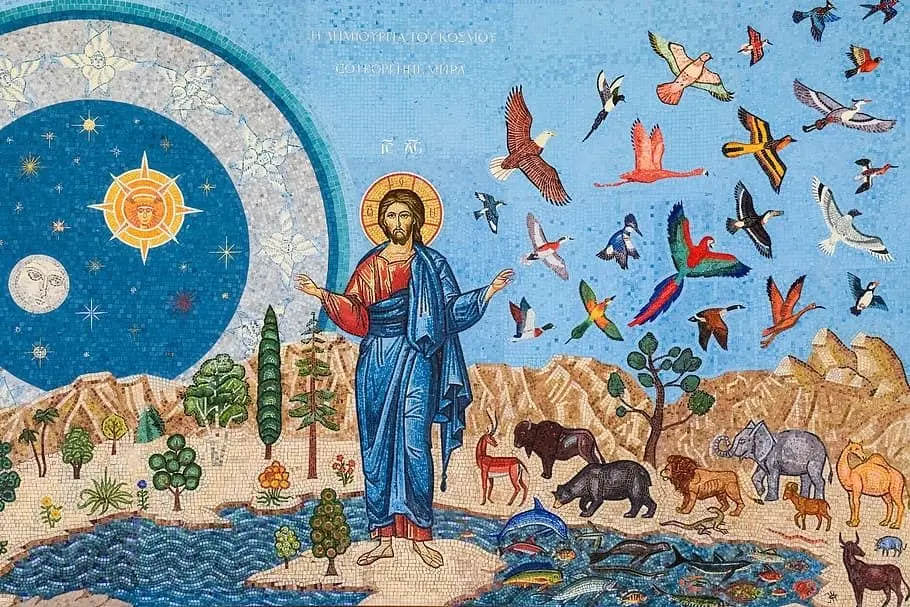
The created order serves as humanity's primary educator concerning the divine nature. The Apostle Paul articulates this with theological precision, asserting that God actively reveals Himself through the visible world, leaving humanity without excuse:
"Because that which may be known of God is manifest in them; for God hath shewed it unto them. For the invisible things of him from the creation of the world are clearly seen, being understood by the things that are made, even his eternal power and Godhead." — Romans 1:19–20 (KJV)
Creation is not a silent backdrop but a revelatory teacher. Yet its teachings are necessarily fragmented: the sun reveals one aspect of God, the moon another, the mountains another still. In a similar way, the Holy Scriptures function as an incarnational medium — a physical book, a tangible artifact, serving as a vessel for spiritual reality, its symbols and narratives pointing toward their consummation in the person of Jesus Christ.
The Logos Incarnate: Christ as the Ultimate Revelation
While creation and Scripture are vital modes of revelation, they are ultimately preliminary and partial. Jesus Christ, as the incarnate Logos, is the archetype of all symbols and the consummation of God's self-disclosure. In His person, the fragmented truths dispersed throughout the natural world are gathered into a single, perfect whole. Where creation reveals aspects of God, Christ reveals God fully — superseding all prior revelations and establishing Himself as the supreme teacher of creation, the ultimate point through which a complete knowledge of God may be received.
The incarnational principle, which begins in the created order, therefore finds its zenith in the Incarnate One, who becomes the exclusive point of contact between God and humanity.
Christ the Theanthropos: The Sole Mediator, Temple, and Teacher
The unique identity of Jesus Christ as the Theanthropos — the God-man — carries singular theological weight. In His person, what was once only a theoretical possibility becomes a tangible, localized reality: genuine communion between the divine and the human. Christ is not merely a messenger from God; He is the very location of divine-human encounter, the one mediator, the living temple, and the supreme teacher for all who seek the Father.
The Great Nexus: The Union of Divine and Human
Scripture and sacred tradition draw upon a rich tapestry of images to describe Christ's mediatorial role. He is the ark of God and man, the sacred vessel containing both natures. He is the meeting place where the infinite and the finite converge. He is Jacob's ladder, the pathway by which humanity ascends to God and God descends to humanity. He is the temple, the sanctuary where God and humanity are united without barrier. The theological implication is unequivocal: the physicalization of the Logos is essential and instrumental to the communion of God with man. In Christ, a perfect exchange becomes possible, for He is the living transporter of both divine and human nature, actively bridging what would otherwise be an unbridgeable distance.
The Supreme Teacher: The Locus of All Truth
Christ's role extends beyond mediation to that of the ultimate educator. The Apostle Paul declares that believers have been "taught by him, as the truth is in Jesus" (Ephesians 4:21, KJV), locating all essential truth — concerning God, humanity, and creation — exclusively within Christ's person. To learn truth is to learn Christ. This primacy is reinforced by the ministry of the Holy Spirit, who is sent to guide believers "into all truth." Since all truth is located in Jesus, the Spirit's work is to lead the faithful ever deeper into Christ, confirming His position as the singular source from whom genuine knowledge of God flows.
Having established Christ as the definitive means of divine communion, we must turn to the ultimate goal of that communion: theosis.
Ontological Pursuit: Theosis and the Quest for Immortality
The ultimate aim of the Christian life extends beyond soteriology — salvation from sin's penalty — into something more radical. The faith's final purpose is the transformation of human nature itself, a process the Church Fathers called theosis, or deification. This is not a call to moral self-improvement but an active and conscious pursuit of immortality through progressive conformation to the divine image, which is Christ Himself.
To be clear about the distinction being drawn: soteriology addresses the question of how human beings are saved from sin and its consequences, but theosis goes further, describing the deeper Eastern Orthodox understanding of salvation as a real participation in divine life — a transformation not merely of legal standing before God, but of one's very being.
Beyond Morality: Conformation to the Divine Image
The audacious claim of the Christian mystery is that God seeks to turn human beings into gods — not by nature, but by grace, through participation in the divine life. The key to understanding this transformation lies in a precise theological distinction: Christ the Logos is the singular, uncreated Image of God. The believer, in turn, is called to become the image of the Image, the icon of the Icon. This distinction preserves the ontological uniqueness of the Son while defining the created human destiny as a participation in that Image through conformity to it.
Seeking Glory, Honour, and Immortality
This pursuit is not a passive hope deferred to the afterlife but an active discipline undertaken in this one. The Apostle Paul frames it as a deliberate quest, setting it against the path of perdition:
"But after thy hardness and impenitent heart treasurest up unto thyself wrath against the day of wrath… To them who by patient continuance in well doing seek for glory and honour and immortality, eternal life." — Romans 2:5, 7 (KJV)
Glory, honour, and immortality are qualities to be actively sought and acquired, and their exclusive source is Jesus Christ. He is, by definition, the very life that is being sought — for Christ is the indestructibility of life; Christ represents deathlessness. In Him alone is incorruptibility found, for in Him are vested all the divine energies of God, which we call grace. The ontological pursuit of man is therefore, and can only be, Christ Himself.
This theological goal, however, is not without precedent. Its possibility was demonstrated long before the Incarnation in the life of the patriarch Enoch, the scriptural archetype of this divine pursuit.
The Enochian Prototype: Insights for Walking with God
The enigmatic life of Enoch, recorded with striking brevity in Genesis 5, serves as a crucial pre-Incarnation case study in the mechanics of theosis. Long before Christ made this path universally accessible, Enoch established the foundational framework — the "Enochian Order" — for understanding the process and outcome of genuine communion with God. His life demonstrates that walking with God is a divinely initiated education that culminates in the transcendence of death itself.
Transcending Death through Communion
The genealogical record of Genesis 5 follows an unbroken refrain: a man "lived… and he died." This cadence of mortality is broken only once. In stark contrast to every name that precedes and follows him, the testimony concerning Enoch stands apart:
"And Enoch walked with God: and he was not; for God took him." — Genesis 5:24 (KJV)
The theological correlation is direct and inescapable. Walking with God leads to deathlessness. Where others simply died, the one who walked with God transcended death, because his communion with the eternal God imparted to him the very properties of eternity.
The Mystery of Initiation: Education by the Logos
This unparalleled outcome raises an important question: where did Enoch receive his teaching? His communion with God was not an intuitive act stumbled upon by chance; it was a mystery requiring divine instruction. The answer is encoded within his very name. The Hebrew Hanok carries the meaning "initiated," "dedicated," and "educated." This etymology signals that the walk with God is not a path one discovers independently but a sacred order into which one must be initiated and educated by a divine teacher.
Faith as the Trans-Generational Principle
The New Testament identifies Enoch's initiator. The Epistle to the Hebrews declares, "By faith Enoch was translated that he should not see death" (Hebrews 11:5, KJV), establishing faith as the operative principle. The Apostle Paul, in turn, reveals the source of such faith: "So then faith cometh by hearing, and hearing by the word of God" (Romans 10:17, KJV). The logical synthesis is unavoidable: for Enoch to have possessed the faith that enabled his translation, he must have heard the Word of God — the pre-incarnate Logos. It was the eternal Christ who served as the timeless Initiator and Educator, drawing Enoch into a communion so deep that it conquered death.
This Enochian archetype, once a rare possibility for a single patriarch, finds its perfected fulfillment and universal accessibility in the life of the Christian believer through the Incarnate Christ.
The Christian Life is the Enochian Order Perfected
The contemporary Christian life is nothing less than the full realization of the Enochian pattern. Through the Incarnate Christ, the path of walking with God has been transformed from a singular exception into a defined, accessible reality for all believers. This perfected order is sustained by grace, pursued through spiritual discipline, and nourished by the sacraments of the Church.
Christ as the Life-Source: The Dynamics of Grace
The believer's total dependence on Christ is illuminated through a series of powerful analogies: Christ is the Vine, our life source; the Sun, our energy source; Electricity, the power that actualizes potential. From this emerges a crucial principle — any spiritual deficiency, whether in knowledge, peace, or holiness, is ultimately a deficiency of the magnified presence of Christ. He is the singular solution for the full range of human need, for at His revelation He becomes what the situation demands.
The Praxis of Theosis: Yielding to the Spirit and Sacramental Grace
The modern expression of walking with God takes shape through concrete spiritual practices. The first is yielding to the Spirit — the constructive, ongoing work of God in the believer's soul. As the Spirit prompts the believer to forgive, to love, to pray, and to wait, that person is progressively conformed to the divine nature, becoming a true child of God who is "led by the Spirit of God" (Romans 8:14).
This process is profoundly nourished by the Sacraments, and above all by the Holy Eucharist. As the sacramental consummation of the incarnational principle, the Eucharist is a physical means through which the believer partakes directly of Christ's incorruptible life. In its celebration, the Church does not merely commemorate a past event; it re-presents Christ's death, bringing that singular salvific act to bear upon the present moment and applying its sin-destroying, life-giving power to those who receive it. The consistent partaking of Christ's body and blood systematically weakens the grip of sin while imparting the divine life that theosis requires.
Together, grace, discipline, and sacrament constitute the modern expression of the Enochian order — a realized path that leads the faithful toward deification.
Realized Path to Deification
The Enochian walk with God is not an ancient anomaly. It is the definitive archetype of the Christian journey toward theosis — a path of divine initiation and communion, first modeled by a patriarch through faith in the unseen Logos and now made universally accessible through the Incarnate Logos, Jesus Christ. This framework transforms our understanding of the faith entirely, moving it from the realm of abstract belief into that of tangible, lived reality.
God reveals Himself through the incarnational principle, which finds its perfect expression in Christ — the sole mediator and supreme teacher. The ontological goal of that revelation is not merely forgiveness but deification: the glorious pursuit of immortality through conformation to the Son. This sacred path, prototyped by Enoch, is now the inheritance of the Church, realized through a life of yielding to the Spirit and sustained by the sacramental grace that flows from Christ, our inexhaustible source.
This understanding restores to the Christian faith its profoundest meaning. It is not a religion of moral codes but a participatory mystery — a realized ontology. It is a divinely initiated and perfected Enochian Order for transcending corruption, conquering death, and partaking in the very life and nature of Almighty God.