The Resurrection of the Son of God: An Initiation into Deathlessness
Click to Download Full Edited Transcript
Enoch B Mnisi, DD
Christianity, at its core, is not a mere ethical system or a religion preserved in texts and traditions. It is a profound mystery religion centered on the offer of immortality. The Resurrection of Jesus Christ is the singular event that validates this offer, transforming a theoretical possibility into a lived, participatory reality. The Christian proposition is not one of abstract belief but of tangible initiation into a new order of being — one fundamentally different from the fallen state of humanity. Through an examination of the Resurrection's theological significance, the role of Christ as the sole divine educator, and the biblical archetype of Enoch, this essay argues that the Christian faith is fundamentally an initiation into deathlessness, achieved through active communion with the risen Lord.
The Unveiled Mystery: Life and Incorruptibility
Before turning to the Resurrection itself, it is essential to understand the framework within which Christianity operates — that of a mystery religion. This is not a peripheral designation but a spiritually significant one, for it shifts the focus from a body of public doctrines to a revealed truth intended for the initiated: a truth centered on the conquest of death. It is this framework that explains the distinction between those who perceive only parables and those to whom the inner workings of the divine economy are opened.
The Initiated and the Uninitiated
The distinction between the initiated — the ecclesiaEkklēsiaThe assembly called out by God: the Body of Christ gathered in every place and every age. — and those "outside" is foundational to the Christian revelation. When the disciples asked Jesus to explain a parable He had shared with the crowds, His response made this division explicit: "unto you is given to understand the mysteries of the kingdom… but to them it is not given." For those outside, truth is presented in parables — accessible in form but veiled in depth — concealing profound realities from those not yet prepared to receive them. For the called, those same parables serve as revelatory expressions of truths "kept hidden from the foundation of the world." The Christian faith, therefore, is not a public philosophy offered to all who inquire. It is a mystery into which one is called, prepared, and initiated.
The Four Pillars of the Divine Mystery
At the heart of this revealed mystery are four interconnected pillars that form the bedrock of Christian theology. These are not abstract ideals but the foundational properties of the divine nature, offered to humanity through Christ, and constituting the very matrix through which believers come to relate to God: Life, a state of being that is divine in origin and eternal in scope; Immortality, the quality of being exempt from death; Indestructibility, the inability to be undone or annihilated; and Incorruptibility, freedom from decay, corruption, and the degrading effects of sin. Once initiated into this mystery, the believer must be educated in the transmission and experience of that life, so that it becomes a living practice and a vital participation — not a distant theological concept. And that mystery would remain precisely that — distant and theoretical — were it not for the singular event that makes it accessible to humanity: the Resurrection of the Son of God.
The Supremacy of the Resurrection
To grasp the Christian proposition in its fullness, one must understand why the Resurrection is the non-negotiable anchor of the faith — not merely as a historical occurrence to be acknowledged, but as the absolute pillar of Christian salvation and theology.
The Lynchpin of Salvation
Writing to the Romans, the Apostle Paul establishes the Resurrection as the orienting point of the believer's salvation. The formula Paul articulates is not rooted in legal obedience or moral achievement, but in a heartfelt, personal conviction: "if thou shalt confess… and shalt believe in your heart that God hath raised him from the dead, thou shalt be saved." (Romans 10) This belief is so pivotal because it is the ultimate affirmation of God's victory over sin and death — the very forces that alienate humanity from its Creator. To believe in the Resurrection is to accept that this victory is real and that it is available to oneself.
The Defining Feature of Christianity
The Resurrection is also what fundamentally sets Christianity apart from every other world religion. It is only through this event that deathlessness and true immortality are offered to humankind. Other systems may offer ethical guidance, philosophical wisdom, or spiritual discipline — but Christianity alone presents a verifiable conquest of death in the person of its founder. Paul's logic is inescapable: "if there be no resurrection of the dead, then Christ is not risen. And if Christ is not risen, then our faith is in vain." The inverse provides the bedrock of Christian hope: because Christ is risen, faith is not empty, and the resurrection of the dead is an established reality.
The Cosmic Significance of the Risen Christ
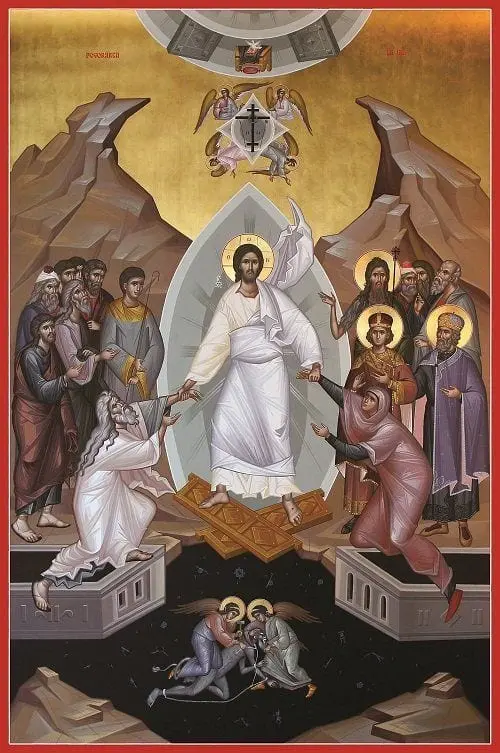
The Resurrection extends its significance beyond human salvation to the cosmic order itself, revealing the very nature of divine power. It stands as the greatest event in the history of creation, second only to the Incarnation of the Son of God, and is the climactic act of God's redemptive plan. In raising Jesus from the dead, God expended a measure of power previously unseen in creation — an act in which God, as it were, "stretched himself," demonstrating a power "that he had not yet before." This was the first introduction of the hyper ballo megatos — the exceeding greatness of His power — not merely a display of great force, but the demonstration of an entirely new kind of majestic power, through which the finality of God's victory over death was realized. The Resurrection is thus the ultimate symbol of triumph: death has been destroyed, and divine and eternal life now sits enthroned at the center of creation.
The Crucifixion: Fulfilling the Mission and Conquering Mortality
The glory of the Resurrection cannot be understood apart from the purpose of the Cross. While the empty tomb is the sign of victory, the Crucifixion was the battlefield on which that victory was won. It was the necessary act by which Christ fulfilled His incarnational mission, dealt decisively with the problem of sin, and opened the pathway to the immortal life secured through His rising.
Remedying the Fall of Man
The Cross was the divine remedy for the chasm opened between God and humanity by Adam's transgression. To save humanity entirely, Christ had to assume humanity entirely. He became everything we are — subject to temptation, suffering, and death — so that He might rescue us from the consequences of the fallen state. As the ultimate sacrifice offered to the Father, His death healed the broken fellowship between the divine and the human.
The Final Victory Over Sin
His death was not a defeat but a strategic conquest. On the Cross, He "condemned sin in the flesh," ending its terrorizing reign over humankind. In being nailed to the tree, He buried sin on the Cross, securing a final and eternal victory. This was the prerequisite for immortality, for it is only by decisively dealing with sin — the very source of death — that the way to life could be opened.
The Reopened Way to the Tree of Life
This victory finds its most vivid expression in a profound reversal of the imagery from Genesis. After the Fall, God placed a cherubim with a flaming sword to guard the way to the tree of life. At the Cross, that divine guard is transformed. The flaming sword is gone. The way that was sealed is now open. There is no longer a cherubim standing with a weapon of exclusion. Instead, there is a cherub holding out "the vase of the blood saying, 'Come all ye who seek after life, who seek after indestructibility… Come all ye to the tree of life. Come all ye to the river of life, and thou shalt be cured.'" The Cross thus represents the final resolution of the problem of sin and the reopening of the path by which humanity may once again partake of the divine nature — a path now accessible to all through the One who achieved this victory.
Christ the Archetype: The Sole Educator of an Experiential Reality
Having established both the importance of the Resurrection and the purpose of the Cross, we turn now to the person of Jesus Christ as the archetype, the source code, and the sole authorized educator of creation. It is through Him that the promise of immortality transitions from a concept into a vital, participatory experience. He does not merely point to the way; He is the way.
The Unique Authority of the Chief Educator
Christ's authority to educate humanity in the things of God is absolute and unique, grounded in His very being. Scripture provides a threefold testimony to this: He knows man perfectly, for "he needed no man to tell him about man, for he knew everything that was in man"; He alone has seen God, for "no man hath seen God at any time except the Son who is in the bosom of the Father"; and He is the agent of all creation, for "all things were made by him and nothing was made that was made without him." Because He is the perfect synthesis of divine knowledge and human experience, Jesus is the only qualified Rabbi capable of inducting mankind into the theology of God and the reality of divine life.
Participation Over Theoretical Knowledge
The education Christ offers is not academic but experiential, because in Christianity, one learns by impartation and communion. This is the principle of participation, most memorably expressed in the analogy of the vine and the branches — Christ as the life source, the mainstation of divine energy, and believers as the branches through which that life flows. This stands in sharp contrast to the hollow religiosity of modernity, where faith is too often reduced to a passive, non-participatory exercise of emotional sensitization without true communion. Christian formation is achieved through active participation. One does not merely study reality; one partakes of it.
The Evidence of Transfigurative Power
Christ's authority to transform believers from mortal to immortal rests upon His demonstrated power to convert matter and reality itself. In the wilderness, Satan acknowledged this power implicitly, demanding that He "command that these stones be made bread" — a profound admission from the adversary that the Son of God possesses the authority to convert one substance into another according to His will (Matthew 4). At the wedding in Cana, Christ responded to human impossibility by turning purification water into fine wine — an act of transubstantiation, a public demonstration of His power to draw a superior substance from an inferior one (John 2). These prior demonstrations provide the necessary context for the Last Supper. When Christ takes bread and wine and declares, "This is my body… This is my blood," He is not speaking in symbols (Matthew 26). He is enacting the very power of conversion He has already shown the world. The Eucharist is therefore not a memorial but a real, tangible participation in His immortal life, made possible by His proven authority over creation. Christ is the educator who not only teaches the path to deathlessness but provides the means of transformation through communion with His own being.
The Curse of Adam and the Hope of Enoch
To fully appreciate the life offered in Christ, one must first understand the default condition of humanity as inherited from Adam. A close theological reading of the genealogy in Genesis 5 reveals a profound paradox: God, who cannot die, created man, and yet man dies. This "deviation of experience" introduces the curse, and it is thrown into sharpest relief by the radical exception of Enoch — who provides the archetypal pattern for transcending mortality altogether.
The Biological Procession of Adam's Gene
The fifth chapter of Genesis presents a relentless and tragic pattern. For each descendant of Adam, the biography follows a grimly predictable formula: he lived, he begat sons and daughters, he lived a certain number of years, "and he died." This final clause punctuates every life — from Adam to Seth to Enos and beyond, without exception. This is the curse: the biological procession of Adam's gene, the inherited destiny of fallen humanity. Death, not life, is the default inheritance of those who descend from Adam — a profound aberration from what God originally intended.
The Profound Exception of Enoch
Within this lineage of death, one name stands in radical defiance of the established pattern: Enoch. His biography begins the same way as his forefathers — he lived, he begat a son — but a crucial detail is then added: "And Enoch walked with God." This addition is not incidental. It is the direct cause of what follows. The expected conclusion, "and he died," is conspicuously absent. In its place stands a statement of profound mystery and hope: "and he was not, for God took him." Enoch escapes the curse of Adam, transcending mortality not by any power of his own, but through his intimate communion with God.
The Principle of Transferred Life
Enoch's life establishes a foundational principle for all who would seek to overcome death: deathlessness is inextricably linked to walking with God. It is in this intimate communion that the indestructible, immortal life of God is transferred to man. Enoch stands as the first human testament to the possibility of escaping the Adamic curse — proof that divine life can be participated in, and that this participation is the key to transcending the biological destiny of death. He is the great prototype, laying the groundwork for the ultimate fulfillment of this principle in the person and work of Jesus Christ.
Christological Perfection: Participating in the Divine Life
This final section draws together the preceding themes, presenting Jesus Christ as the New and Greater Enoch — the One who not only demonstrates the path of deathlessness but becomes the very path itself. Through Him, the Enochian principle is perfected and made universally accessible through what may be called the technology of the Christological life: the means by which believers leave behind the Adamic curse and actively participate in the divine nature.
The Fulfillment of the Enochian Principle
If walking with God is the path to deathlessness, then Jesus — who is God incarnate — becomes the perfect initiator and educator into this reality. His three-day sojourn in death was not a failure but a strategic act: He entered the domain of death, absorbed its power, and permanently destroyed it from within. Having accomplished this, He is now "alive forevermore" — the perfect and eternal prototype for all who would follow. In Him, what Enoch foreshadowed is finally and fully realized.
The Technology of the Christological Life
The Christian faith provides a clear and participatory way of accessing this divine life. It is not a passive system of belief but a dynamic process of exchange that transforms the believer from the inside out. The primary step is an acknowledgement of one's own deficiency — a posture of humility that mirrors Christ's own self-emptying. In the same way that He emptied Himself of His divinity to take on humanity, so the believer must lay aside their humanity to take up His divinity, confessing their own incapability in order to receive His all-sufficient capability. From this foundation, consistent engagement with the Word of God and communion through prayer are not merely devotional exercises — they are the literal instruments of transformation. As the Apostle Paul explains in 1 Timothy 4:5, every creature of God "is sanctified by the word of God and by prayer." These are the active means by which the believer is progressively purified and aligned with the divine nature. Central to this participation is the Eucharist. As established by Christ's demonstrated power of conversion, the bread and wine are not mere symbols but are His true body and blood. To partake in the sacraments is to commune with and receive the very substance of the immortal, incorruptible, and indestructible life of the risen Christ — a non-negotiable act of living union with the One who conquered death. The Christological life is thus a dynamic process wherein our mortality is supplanted by His immortality through intentional, active, and sacramental participation in Him.
Significance of an Immortal Hope
When properly understood, the Christian faith reveals itself not as a moral code but as an initiation into the mystery of deathlessness. Its central claim — that a man rose from the dead — is not merely a historical footnote but the validation of God's ultimate offer to humanity: a full and eternal participation in the divine life. This essay has traced that reality from its framing as a revealed mystery of life and incorruptibility, through the Resurrection as its theological bedrock, the Cross as its gateway, Christ as its sole educator, Enoch as its prototype, and the sacramental life as its perfected means of communion.
The Enochian principle — that walking with God leads to deathlessness — finds its ultimate fulfillment in the technology of the Christological life. The prayer, the study and meditation of the Word, and the sacraments offered in the Church are the perfected and universally accessible means of that same communion Enoch first pioneered. The promise of Christianity is not an abstract hope to be admired from a distance but a present reality to be entered, not by detached study but by impartation. Because Christ is risen, death has been destroyed. The pursuit of incorruptibility and eternal life is now the rightful and achievable inheritance of all who are initiated into the life of the Son of God — the firstborn from the dead and the author of an immortal hope.