God: The Fountainhead of Creation
Introduction
Why do so many believers pray without ever being changed by prayer? Why can a congregation sit under decades of preaching about the cross and yet remain strangers to the transformation the cross was meant to accomplish? The teaching that occasions this essay begins from a diagnosis rather than a doctrine: that the deficiency is not one of information but of understanding, the capacity, as the Apostle Paul urges the Corinthians, to move beyond spiritual infancy into a matured grasp of the things of God (1 Corinthians 14:20). Understanding, in this sense, is not mere data acquisition. It is the ability "to put the puzzle together", to connect what is revealed to what is real, and to let that connection govern the direction of a life.
This essay argues a single thesis, built in three movements. First, that a defective foundation in first principles, beginning with a false or truncated account of who God is and what creation is for, inevitably produces a defective spiritual life, because a wrong premise cannot yield a right conclusion. Second, that the prevailing Western, Protestant account of salvation, being predominantly forensic (juridical, legal, extrinsic) rather than ontological (transformative, participatory, intrinsic), leaves the believer permanently divorced from the very reality Christ's death was meant to confer, and manufactures doctrine after doctrine to paper over that gap. Third, that intercession, and prayer as such, cannot be properly understood, still less rightly practiced, until this ontological foundation is recovered, because intercession is not a human religious technique but a Trinitarian, divine reality into which the believer is invited to participate.
The stakes of this argument are not academic. A soul that misunderstands salvation as a legal transaction will pray as one petitioning a distant magistrate. A soul that understands salvation as participation in the divine life, theosisTheōsisNot that we become God by nature, but that by grace we are drawn into His life: “partakers of the divine nature” (2 Peter 1:4)., the process by which the creature is united to the energies, though never the essence, of the Creator, will pray as one groaning from the depths of a being already being remade. The difference between these two postures is the difference between religion and communion.
The Importance of Understanding in the Spiritual Life
The essay opens not with a doctrine but with a principle of human flourishing: understanding is the precondition for benefiting from anything of value, whether that value is material, relational, vocational, or spiritual. The lack of understanding places you by default at a disadvantage. This is not offered as a truism but as an axiom upon which the rest of this essay relies. Those who understand, who can perceive relationships, causes, and consequences, are positioned to receive what those without such perception cannot even recognize when it is offered to them.
This axiom finds its scriptural anchor in Paul's rebuke to the Corinthian church: he does not object to their remaining childlike in malice, but insists that "in understanding be men" (1 Corinthians 14:20). The distinction is deliberate. Innocence with respect to evil is a virtue; immaturity with respect to comprehension is a liability. Understanding is the trained capacity of the reasoning faculty to grapple with, and rightly interpret, reality, and by tying this capacity directly to the moral life through the category of impulsiveness.
Impulsiveness on this account, is action divorced from reasoning, the opposite of sobriety, which I define not primarily as abstinence but as the disposition of one who has engaged with all the facts and deduced a conclusion before acting. This is a substantial theological claim: sin operates characteristically in the register of the impulsive. Satan's strategy is not fundamentally to argue men into sin but to solicit a reaction that bypasses reflection altogether, "act now, act now, act now." The example offered is David's numbering of Israel (2 Samuel 24), an act instigated by satanic provocation that operated precisely by circumventing wisdom rather than by persuading against it. The tragedy of impulsive sin, I note with pastoral gravity, is that reflection arrives only after the act, when the consequences have already begun to unfold, and by then, the consequences must be lived with, not merely regretted.
Against this pattern, is reflected in the paradigm of David and Solomon: David, who never lost a battle, and Solomon, who never fought a battle, both functioning within the spectrum of the divine wisdom of God. Their success is attributed not to superior natural cunning but to a sagacious mind, a mind whose perceptive capacity had been elasticized by divine engagement, chiefly through sustained meditation on the law. David's own testimony, "I have more understanding than all my teachers: for thy testimonies are my meditation" (Psalm 119:99), is evidence that understanding is cultivated, not innate; it is the fruit of prolonged, active engagement with revelation, not passive exposure to it.
Here’s my pastoral indictment: believers regularly hear the word without wrestling with it, without asking why a thing is said, from where it proceeds, and toward what outcome it moves, and consequently the word "yields no fruit." The cares of the world and the pressures of circumstance siphon away the energy required for this contextualizing labor. Hebrews 4:12 stands behind this diagnosis, though unstated in these terms: the word of God is living and active, but its capacity to divide soul from spirit, to discern the thoughts and intents of the heart, presupposes a hearer who has submitted to its penetration rather than merely absorbed its sound. Our opening prayer makes this explicit, asking the Father that the word "hammer and chisel out the stony heart", an image drawn from Ezekiel's promise of a heart of flesh replacing a heart of stone (Ezekiel 36:26), precisely because understanding is not an intellectual accessory to salvation but the very instrument by which the heart is remade.
It is this principle, that a defective foundation produces a defective structure, that licenses the turn to what we call "first principles". If understanding requires beginning at the root and building upward, then any teaching on prayer or intercession that does not first secure its account of God, creation, and man will build a life that is alien to the will of God.
The Forensic Captivity of Protestant Soteriology
Having established that wrong premises yield wrong conclusions, I will turn to what I believe is the central premise error of modern Western Christianity: the reduction of salvation to a forensic or juridical category. This is the essay's most theologically pointed claim, and it deserves careful unpacking, because i do not merely criticize Protestant practice but Protestant ontology, its account of what actually happens, or fails to happen, in the death of Christ.
The diagnosis runs as follows. Protestantism, as the majority theological grammar of the Western world, conceives of salvation predominantly in legal terms: Christ dies, and God legally forgives; Christ dies, and God legally justifies. The operative claim is that the significance of Christ's death is exhausted in a legal declaration, a change in status before a divine tribunal, rather than in an ontological transformation of the one for whom Christ died. There is no vital connection, vital link that adds substance that results or consequences the transformation of the one whom Christ died for. On this reading, the believer possesses a verdict but not necessarily a nature; an acquittal but not necessarily a new mode of being.
I argue that this forensic starting point generates a chronic instability in Protestant theology, because a legal pronouncement, unlike an ontological transformation, requires the believer to work out for himself how that pronouncement is to be inhabited. If something is legal then you have to make up your mind how to appropriate the reality of that legal pronouncement. The proliferation of doctrines, sola fide and sola gratia, faith alone and grace alone, is interpreted not as an error of overemphasis but as a structural symptom: an attempt to fill, by doctrinal machinery, the conceptual vacancy left by a soteriology that never explained how Christ's death actually changes what a person is. Where there is no clear account of ontological participation in Christ, doctrine multiplies to compensate for the missing substance.
Set against this is my essays constructive claim: that the true, apostolic doctrine of salvation is not juridical but sacramental and participatory. We cannot be gods if we are not ontologically transformed. We cannot be partakers of the divine nature legally. This is a direct invocation of 2 Peter 1:4, that believers are called to be "partakers of the divine nature", a text that, on the a simple reading, cannot be satisfied by a merely forensic account of salvation, because a legal status does not constitute participation in a nature. Nature is not conferred by verdict; it is conferred by union.
The Lord Jesus and Apostles grounds this participatory soteriology in the sacraments, treating them not as symbolic ordinances appended to an already-completed legal transaction, but as the very means by which the ontological gap between Christ's accomplished work and the believer's transformed life is bridged. Two texts anchor this argument. First, baptism: "He that believeth and is baptized shall be saved" (Mark 16:16), and the scripture stresses, with evident rhetorical weight, that Christ did not say "he that believeth only shall be saved," but conjoined belief to baptism as jointly constitutive of the saving reality. Second, the Eucharist: "Except ye eat the flesh of the Son of man, and drink his blood, ye have no life in you" (John 6:53), a statement I insist cannot be reduced to legal metaphor. That is not legal. That is a sacramental mandate of participation. To have no part in Christ apart from this eating and drinking is to say that salvation is inherently sacramental, not merely declarative.
The pastoral consequence of forensic soteriology on this account, is a peculiar and dangerous permissiveness: because justification is treated as a legal fact secured by faith alone, sanctification can be indefinitely deferred or even abandoned without apparent contradiction, “a Christian can still sin and they'll be saved... You live your whole life thinking it's fine." This is a symptom of ontological confusion rather than mere moral laxity: if salvation were understood as transformation rather than acquittal, continuance in unrepentant sin would be self-evidently incoherent, because it would mean the professed new nature had not, in fact, been received. For example, a minister who first preaches that a believer must be delivered from generational curses, and then insists that same believer is already fully "seated with Christ," has unwittingly confessed that Christ's death, on his own operative theology, was not fully efficacious, for if it were, no lingering bondage would remain to be delivered from. This is offered not as an isolated pastoral inconsistency but as the predictable fruit of the forensic premise: a Christianity that begins with a legal fiction will always need supplementary doctrines to explain why the fiction has not visibly changed the believer's life.
It should be noted, in fairness to the historical breadth of Christian reflection, that classical Reformed and Lutheran theology has never intended justification to stand entirely apart from union with Christ and the subsequent work of sanctification; the forensic and the transformative have, in careful Protestant dogmatics, generally been held together rather than opposed. The essays critique, however, is aimed less at the most careful articulations of Reformation theology than at its lived, popular, congregational form, the "mental ascent" Christianity in which belief in a completed transaction substitutes for ongoing participation. It is this popular form I have chiefly in view when I such a gospel is satanic. It blinds you from fallen yourself so that the consciousness of your need for God is suppressed.
The alternative this essay proposes: ontological, sacramental, participatory salvation, belongs to the theological tradition most fully preserved in the Ancient Tradition and the Patristic witness, where salvation is characteristically described not as a change of legal status alone but as ontological transformation: the process, inaugurated in baptism and sustained through the Eucharist, ascetic discipline, and prayer, by which the human person is progressively united to the divine energies of God. It is this participatory vision, not the forensic one, that the essay insists alone can make coherent sense of what follows: the doctrine of God as the unknowable-yet-participable source of all created reality.
First Principles: God, Essence, and Energies
Having identified the fault line in Western soteriology, we turn, in a methodological move, to the doctrine of creation, because we have to begin from first principles... strip everything down to its raw elements then begin to build everything up. Genesis 1:1 is treated as precisely this: the book of first principles.
"In the beginning God created the heaven and the earth." From this single verse we derive a dense doctrine of divine transcendence and the God-relatedness of meaning. God is the principle of creation, in the philosophical sense of an archē, an originating source without which the thing originated cannot be understood in itself. Creation cannot understand itself apart from God... it is God that gives creation its meaning, it is God that gives creation its purpose, because he is the principle and fountainhead of creation. Crucially, this relation is asymmetrical: creation does not, in turn, confer meaning or purpose upon God. Creation is a byproduct of God, not the other way around.
From this asymmetry we can deduce an apophatic doctrine of the divine essence, a doctrine with clear resonance in the Patristic and especially Palamite (St Gregory of Palamas) tradition of the essence-energies distinction. Because God is the source of createdness, and is Himself uncreated, he cannot be truly described from within the categories of the created order. His being remains mysterious because He is the creator, which means He is outside creation. What can be known of God is not his essence but his activity. Borrowing patristic vocabulary, we call His energies, as distinct from His essence. Everything God does outside of his essence are his activities... it is only through the activities of God that creation truly can relate and fellowship with him. Participation in the divine essence is categorically impossible for the creature, since it would entail becoming God in the strict sense, a fourth hypostasis alongside the Trinity, which is theologically incoherent. But participation in the divine energies is precisely what is offered to, and required of, the creature.
We find scriptural warrant for this essence-energies distinction in the Sinai narrative: Moses's request, "shew me thy glory" (Exodus 33:18), is met with the reply that no man can see God's face and live, but that God will cause his goodness to pass before Moses (Exodus 33:19–20, 22–23). This is a paradigmatic statement of the pattern that governs all creaturely knowledge of God thereafter: not vision of essence, which annihilates, but participation in energies, which sanctifies. This same logic, I argue, resolves the Arian controversy from within: the LogosLogosThe eternal Word of God, through whom all things were made, who became flesh and dwelt among us (John 1:1–14)., Christ, cannot be part of creation and simultaneously be God in the full sense, because to be created is to be ontologically distinct from the uncreated essence that God alone possesses. You cannot say that Jesus is God and then say he's part of creation... because God's essence is uncreated. Christ shares the uncreated essence with the Father; the sons of God and the angelic hosts, however exalted, do not.
From this doctrine of God as the unknowable-in-essence, knowable-in-energy source of all meaning, draws a pastoral and existential conclusion that governs everything that follows: because God is the principle who gives meaning to all created things, your life cannot have any meaning without God... unless God is consulted, your life has no true direction. This is not a pious sentiment but as a metaphysical entailment of the doctrine of creation itself. Every micro frustration and macro frustration of human life is reinterpreted as symptomatic evidence of deficient consultation, a will unsynchronized with the will of its Creator. The correlate scriptural warrant is drawn from Proverbs: "There is a way which seemeth right unto a man, but the end thereof are the ways of death" (Proverbs 14:12), coupled with the warning against being "wise in [one's] own eyes" (Proverbs 3:7) and the promise that the one who fears the Lord will be taught the way he should choose (Psalm 25:12).
Election, Sovereignty, and the Story That Is Not Ours
In the essays exposition of first principles, lets moves next into the domain of divine sovereignty, using Romans 9 as its central text. Paul's account of Jacob and Esau, "the elder shall serve the younger... Jacob have I loved, but Esau have I hated" (Romans 9:12–13), is deployed to establish that the entire narrative of creation, including the destinies of nations and individuals, unfolds according to a purpose that precedes and is independent of creaturely merit. "The children being not yet born, neither having done any good or evil," the distinction between them rested "not of works, but of him that calleth" (Romans 9:11).
The sobering doctrine articulated by Paul himself: that God "will have mercy on whom he will have mercy" (Romans 9:15), that Pharaoh was raised up precisely "that I might shew my power in thee" (Romans 9:17), and that the creature has no standing to interrogate the Creator's purposes, "shall the thing formed say to him that formed it, Why hast thou made me thus?" (Romans 9:20). The theological weight of this section is to relativize the human sense of authorship over one's own story: This is God's story. It's not yours and mine... the director and the one who decides how the story begins and ends is the Creator himself. This is not fatalism in my essays presentation, but a corollary of the doctrine already established, that God alone is the principle who gives meaning to what he has made, and that meaning cannot be self-generated by the creature.
The Fall Before the Fall: Cosmic Rebellion and Human Solidarity in Sin
Lets extend our account of first principles beyond the earth to the wider created order, drawing on the biblical motif of the "sons of God" (Job 1:6; 2:1; 38:7), heavenly beings whose estate was in the spirit, possessing dominion within the heavenly spheres, distinct from, though analogous to, the dominion given to man over the earth. The scripture locates original sin not first on earth but within this angelic order: original sin was not really discovered on earth. It was original in the context of earth. But in the context of the entire universe, there was a being in whom was discovered sin, iniquity, a rebellion the scriptures identifies as the beginning of a cosmic war whose full theological rationale it defers to a subsequent study of Revelations. This rebellion, becomes the pattern for the temptation of Adam and Eve: having lost the heavenly war, the rebellious Satan turned to solicit treason from mankind as well, so that in both instances, the heavenly beings committed treason on mankind, and committed treason against God.
This excursus serves a specific argumentative purpose within the essay's larger structure: everything about me and you, about our tendency, about our mannerisms, about our way of thinking, about the paths we have taken. The doctrine of the fall, cosmic and terrestrial, is not abstract history but the necessary backdrop for my central claim, that human beings do not, by default, pursue God, because they remain largely unaware of their own depravity. I invoke the church of Laodicea, which believed itself "rich, and increased with goods, and have need of nothing," while being in reality "wretched, and miserable, and poor, and blind, and naked" (Revelation 3:17), as the paradigm of unrevealed self-deception. Until a person is revealed to himself, the matter of grace, the matter of mercy, the matter of salvation becomes a non-starter.
The Pharisee and the publican (Luke 18:10–14) are set forth as the essay's controlling parable: the Pharisee, cataloguing his own righteousness, tithing, fasting, praying, remains deluded... hidden from himself; the publican, unable even to lift his eyes to heaven, cries only, God be merciful to me a sinner" (Luke 18:13), and it is this publican, not the Pharisee, whom Christ declares justified. Lets draw the moral directly: he was exposed to the true state of his soul... he saw who he was without God. No accumulation of wealth, achievement, or religious performance can substitute for this exposure, because, as the scripture’s lesson insists, man cannot buy eternal life. Man cannot save himself. Man cannot atone for himself. The warning of Deuteronomy 8, that Israel, once settled in houses they did not build and vineyards they did not plant, must remember it was the Lord who gave them power to prosper, and the cautionary example of Nebuchadnezzar, who looked upon his kingdom and forgot its true source (Daniel 4:30), function as historical case studies of the same self-deceiving pride that afflicts every unregenerate soul, ancient or contemporary.
This section closes the essay's central hinge: true humility cannot be born in a man who thinks he has been truly free. It is in captivity that we appreciate freedom. The recognition of one's own wretchedness is not despair but the necessary precondition for the cry that draws down grace, and this cry cannot be sustained by human effort alone. Men cannot truly touch that grace, the mercy, the dunamis of God without an intercessor.
Prayer is the Cry of the Heart
It is only after this extended foundation, understanding as precondition, ontological soteriology as corrective, the doctrine of God as unknowable-in-essence-yet-participable-in-energy, divine sovereignty, and human self-deception as the obstacle to grace, that this essay arrives at its proper subject: the nature of prayer itself
My claim here is a corrective aimed once again at inherited Protestant habit: We grew up... programmed to think that prayer is just loud mouthing... No, prayer begins in the heart. The true root of prayer is not in eloquence or volume but in the inarticulate groan, a deep sigh that emanates from the depths of your being, that arises when words themselves fail. This is a striking, if implicit, resonance with Paul's teaching in Romans 8:26, that "the Spirit itself maketh intercession for us with groanings which cannot be uttered." Prayer's deepest register lies beneath speech.
Two scriptural touchstones anchor this perspective. First, the divine imperative of Psalm 46:10, "Be still, and know that I am God", read here not as a call to passivity but to interior stillness as the condition for true perception of God. Second, the promise of Isaiah 40:31, "they that wait upon the LORD shall renew their strength", as evidence that the posture of waiting, rather than performative speech, is where divine strength is transacted. These scriptures urge its hearers to shift the basis of our praying... to the depths of our bosom, grounding this shift Christologically: "we have not an high priest which cannot be touched with the feeling of our infirmities" (Hebrews 4:15), and therefore "let us come boldly unto the throne of grace, that we may obtain mercy, and find grace to help in time of need" (Hebrews 4:16).
Lets then turn to the account of the woman with the issue of blood (Luke 8:43–48; Mark 5:25–34) as an image of the relational, rather than transactional, character of true prayer. The exegetical detail I want to highlight is precisely this: the woman touched only the hem of his garment, yet Christ's question was not who touched my garment? but "who touched me?" (Luke 8:45). This is evidence of an powerful relationship that intercession affords us with God, that contact with Christ, however slight in physical terms, constitutes genuine personal encounter, not merely ritual proximity. This is offered as a final corrective to forensic religion: prayer, rightly understood, is not a legal petition lodged with a distant tribunal, but a reaching toward a Person who is himself already reaching toward the one who reaches, as exemplified in Exodus 3:7, where God tells Moses, "I am come down to deliver them... for I have heard their cry."
The Eucharist as the Enactment of Ontological Union
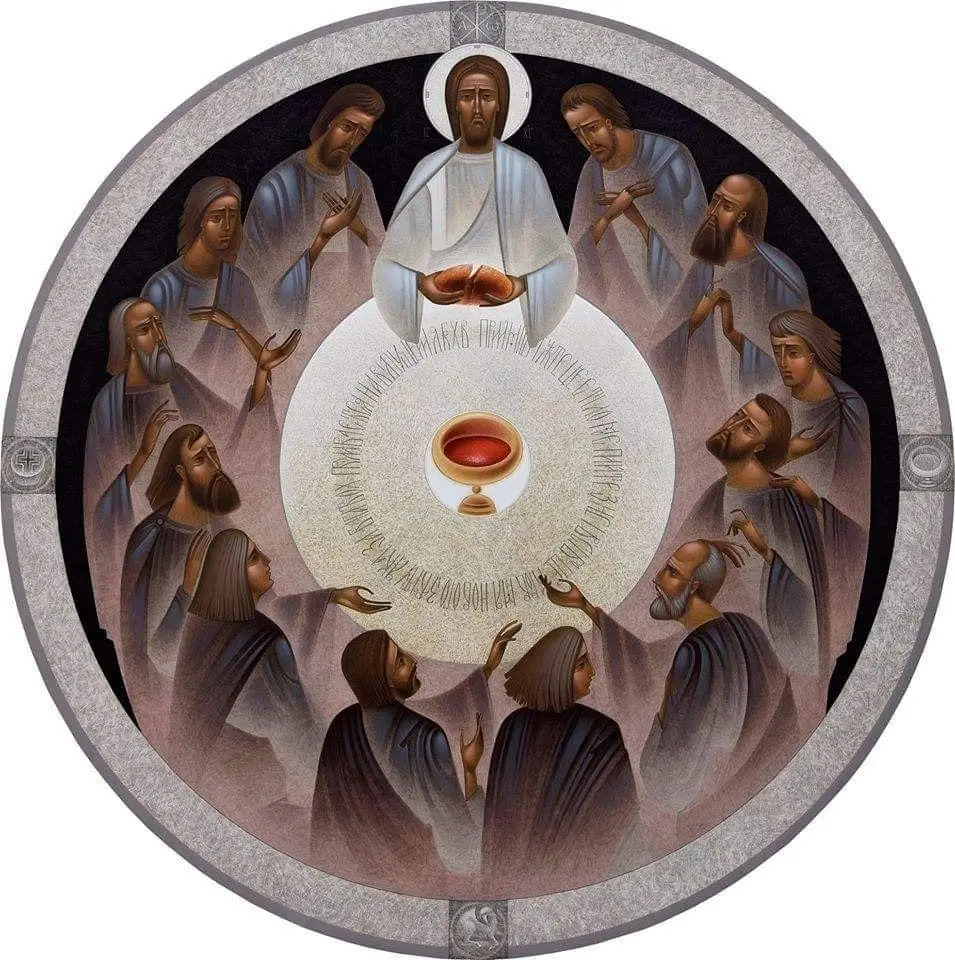
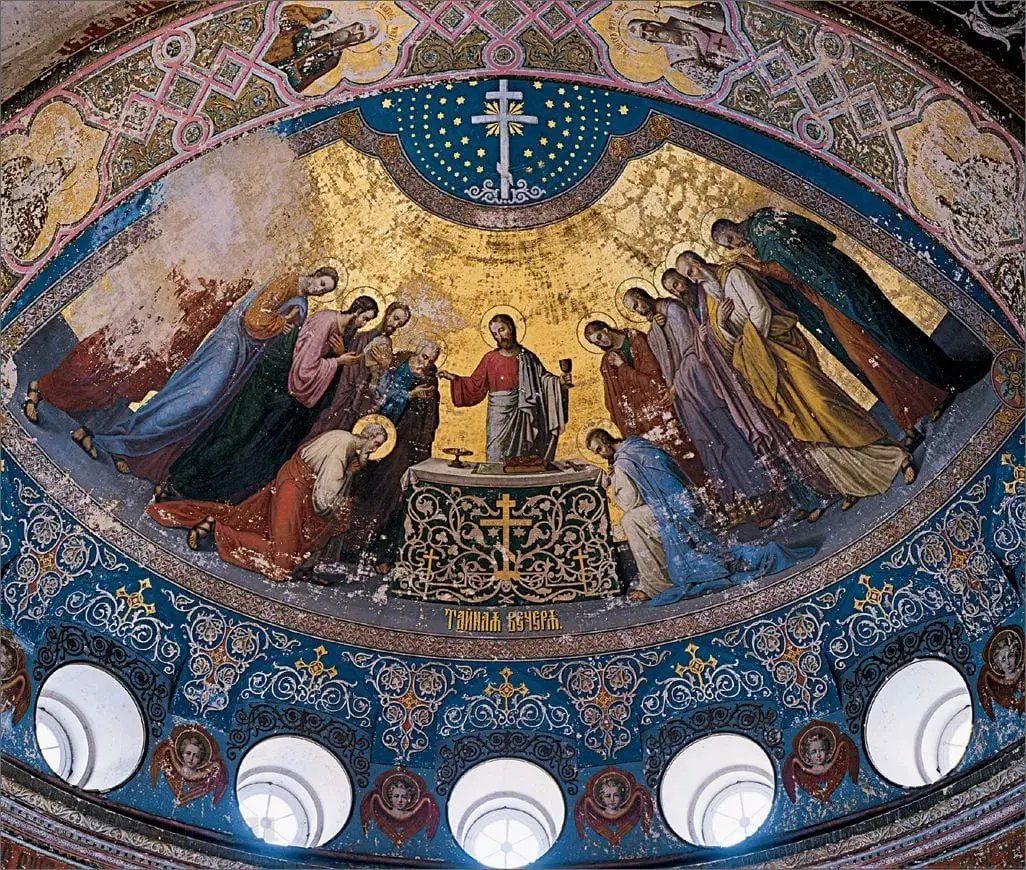
I conclude not with exposition but with liturgical enactment, moving directly from doctrine into the celebration of the Eucharist, a structural choice that is itself theologically significant, since it embodies rather than merely asserts the participatory soteriology argued for throughout. The words of institution are recited in their traditional form, "Take, eat: this is my body, which is broken for you" and "this cup is the new testament in my blood" (drawing on 1 Corinthians 11:24–25 and Luke 22:19–20), accompanied by the invocation of the Holy Spirit to "consecrate" the elements, and the citation of Paul's own liturgical rationale: "as often as ye eat this bread, and drink this cup, ye do shew the Lord's death till he come" (1 Corinthians 11:26).
This closing act of communion should not be read as a mere pastoral formality appended to the essay. Rather, it is the essays own thesis performed: if salvation is genuinely ontological and sacramental rather than merely forensic, then the essay that argues this cannot properly end with argument alone. It must end where the argument itself points, at the altar, in the actual sacramental union to our Lord... in the mystery of the Eucharist. Participation, not merely propositional assent, is the substance of the Christian life.
The End….The Grace of our Lord Jesus Be With You… Amen!