The Instrumentality of Prayer in the Soul’s Communion with the Eternal God
Ontological Origins of the Human Person
To walk the path of prayer is not merely to perform a religious exercise or to seek psychological relief. It is to engage in a profound reclamation of one's very identity. The foundation for a life of sustained prayer therefore rests upon a rigorous, patristic understanding of who we are and where we come from.
When we examine the Hexameron—the six days of creation in the Genesis account—a striking and qualitative distinction emerges in the creative acts of God. When He brought forth the beasts of the field, the vegetation, and the creatures of the sea, He commanded the earth and the waters, and they produced life according to their kind. These creatures were made from the material world and for the material world. Their nature begins, is sustained, and ends within the temporal horizon. They are bounded by the cosmos, beautiful but limited expressions of the divine fiat.
Man, however, stands as a unique and arresting exception in the order of creation. He is not a byproduct of biological complexity or a sophisticated extension of the animal kingdom. While his physical frame was indeed fashioned from the dust of the ground, the defining moment of human existence came when the Creator "breathed into his nostrils the breath of life; and man became a living soul" (Genesis 2:7, KJV). This pnoe—this divine breath—signifies that the human soul is not an emergent property of matter but a substance derived from the very life of God. For this reason, patristic literature describes the human person as the methorios: the boundary-dweller, the ontological bridge between the created and the uncreated, between the material and the immaterial. We exist at the intersection of two worlds, possessing a body taken from the earth and a soul breathed from the mouth of the Eternal.
The implications of this reality for the practitioner of prayer are immense. Because the soul proceeds from God's own substance, man was designed to be God's communing companion—not merely to survive, but to yield pleasure to the Divine and to participate in the uncreated energies of the Creator. This demands a total rejection of the materialist worldview, which reduces human experience to the level of the beast. If the core of our being is substantively connected to the Uncreated, then our ultimate purpose cannot be found in the earth from which our bodies were taken, but in the Spirit from whom our souls were breathed. The soul is, in a very real sense, a stranger in the material realm—a celestial traveler whose constitution demands that its only true home, and its only true interlocutor, is the Eternal God. When understood this way, prayer is no longer a duty. It is a return.
This anthropology determines the entire trajectory of the spiritual life. If man is the methorios, then to live only for the body is to live in a state of ontological treason. We suffer a deep alienation when we attempt to satisfy a soul made of divine breath with objects made of dust. The soul's dissatisfaction with the material world is not a flaw in our design; it is a diagnostic indicator of our high calling—a homing beacon, pressing us back toward the Spirit. As we move from the question of our origin, we must recognize that this divine lineage creates a hunger the material world is fundamentally unequipped to satisfy.
Divine Hunger: Why the Temporal Cannot Satisfy the Eternal
Within the economy of salvation, there is a mechanism that modern believers often misunderstand or resist: spiritual frustration. That persistent, gnawing sense of emptiness that remains even after the accumulation of worldly success is not a psychological malady. It is a divine instrument designed to lead the soul back to its Source.
The soul carries a specific DNA, hard-wired for the infinite. Because the soul is immaterial and eternal, it possesses an inherent capacity—a God-shaped void—that the material world can never fill. The temporal cannot satisfy the eternal; the seen cannot nourish the unseen. God is, in the most precise theological sense, the food of the soul. Just as the body requires bread from the earth to sustain its biological life, so the soul requires the substance of God to sustain its spiritual life.
When a man attempts to feed this hunger with material acquisitions—whether through academic accolades, the building of a corporate empire, or the pursuit of lesser pleasures—he is attempting to nourish an eternal appetite with temporal husks. The path taken matters little: whether accumulating possessions or seeking fleeting consolations in alcohol, relationships, or distraction, the result is the same crushing emptiness. The soul is not a material organ. It cannot be fed by anything that can be touched, tasted, or purchased.
This condition gives rise to what might be called the hijacking of the soul's faculties. In the absence of true communion with God, the soul's capacity for desire becomes arrested and imprisoned within a perpetual cycle of dissatisfaction. The material world becomes a kind of prison, where the soul's energy is expended on objects that have no power to sustain it. The frustration we feel in our material pursuits is the soul's protest against its exile from the Divine—the still, small voice within that cries out that it cannot breathe in the atmosphere of the world.
Yet the strategic value of this hunger is considerable. It functions as a denaturalizing force, pressing a man toward the humble and perhaps desperate conclusion that he needs God more than he needs the world. This is the beginning of wisdom. Only when this need is placed above every temporal claim can the soul begin its arduous journey home. Having understood why we hunger, we must now turn to the only discipline capable of satisfying that hunger: the sacrificial work of prayer.
Burnt Offering: The Sacrifice of the Body in the Arena of Prayer
To enter into the presence of the Almighty is to approach a consuming fire. True prayer is not a casual conversation or a meditative exercise; it is a liturgical act of warfare that requires a sacrifice. Throughout the history of the covenant—from the altars of Abel to the Temple of Solomon—God has remained unapproachable without an offering. In the New Covenant, the focus of that offering shifts from the blood of bulls and goats to the very frame of the believer. The necessity of ascesis, or asceticism, lies precisely here: until the body is offered upon the altar of discipline, true prayer cannot ascend.
The body must be understood as the burnt offering in the arena of prayer. This is not a metaphorical sacrifice; it is a physical reality that involves vigils (agrypnia), long hours of standing, and the intentional endurance of discomfort. The reason is found in the fallen state of our nature, where the intelligence of the flesh actively resists the upward pull of the soul. The body, being of the dust, demands comfort, sleep, and ease. It is the anchor that keeps the soul submerged in the material sea. True spiritual ascent requires that the will of the soul bind the body.
The Apostle Paul provides the scriptural mandate for this: "I beseech you therefore, brethren, by the mercies of God, that ye present your bodies a living sacrifice, holy, acceptable unto God, which is your reasonable service" (Romans 12:1, KJV). This reasonable service—the logike latreia—is to bind the body to the horns of the altar, for an unbound sacrifice will always attempt to flee the fire. When a believer commits to a three-hour vigil, or chooses a hard stool over a comfortable sofa, they are not engaging in masochism; they are engaging in the athletics of eternity, forcing the body to remain in the place of prayer until the resistance of the flesh is consumed. The physical discomfort—the fatigue, the wandering mind, the aching limbs—is the very evidence that the sacrifice is being burned.
The significance of this asceticism is the stabilization of the spiritual life. Many believers suffer from an inconsistent existence, full of zeal one moment and spiritual lethargy the next. This instability is almost always rooted in a refusal to sacrifice the body. We must understand the paradox: what feeds the flesh destroys the soul, and what feeds the soul the flesh finds intolerable. By forcing the body to remain in God's presence, we sever the bridge that the demonic uses to arrest the soul's ascent. The fire of the vigil burns away earthly attachments, allowing the soul to rise as pure incense. If we do not bind the sacrifice, the soul will never reach communion, for it will always be pulled back by a body that demands to be fed, clothed, and rested. We must now turn to understand why the flesh resists so vehemently.
Jungle of the Flesh: Demons, Dust, and the Satanic Framework
To understand the difficulty of prayer, one must understand the environment in which we live. The cosmos—the world system—is not a neutral space. It is a satanic regime, a framework constructed according to the image of the adversary. And the flesh, in its fallen state, acts as a jungle that sustains wild beasts. These beasts are demonic entities—intelligent, strategic, and articulate—whose aim is to maintain their dominion over the human person.
The importance of the body in this warfare is clarified by the curse pronounced upon the serpent in the Garden: "And the LORD God said unto the serpent... dust shalt thou eat all the days of thy life" (Genesis 3:14, KJV). Because the human frame was fashioned from the dust of the ground, the unredeemed flesh becomes, in a real sense, the food of demons. This is the intelligence of the demonic: they do not assault the soul directly, but rather consume the dust of our fleshly appetites—our tempers, our lusts, our idle desires—to gain access to the soul. Their primary assignment is to prevent the soul from entering the eternal arena, and they accomplish this by anchoring the soul to the body's appetites and the world's distractions.
The cosmos functions as a vast dragnet, a soul-market where daily transactions are made—the eternal exchanged for the temporal. Satan has no inherent interest in the kingdoms of the world; he values them only as bait. Every distraction that arises during prayer—the urge to check a phone, the sudden memory of an unfinished report, the impulse toward some mundane task—is a tactic of this regime. These are not merely our own wandering thoughts; they are the bites of wild beasts in the jungle of the flesh, designed to kill the switch of our spiritual intention. The adversary is strategic. He arrives first in prayer, constructing a wall of resistance before the Holy Spirit has even begun to move.
The sober implication is that our existence is transactional. "What shall a man give in exchange for his soul?" (Matthew 16:26, KJV). Every yielding to the flesh is a participation in the enemy's soul-market. To pray is to enter into direct combat with this regime—to deny the demonic their food by withdrawing the flesh from their influence through fasting and vigils. By sacrificing the body on the altar of prayer, we cut the enemy's lifeline. The warfare of prayer is the battle to prevent the flesh from being the medium through which the soul is sold. This leads us to a sobering lesson from the Apostles themselves, who discovered that even the most extraordinary spiritual experience cannot replace the need for constant watchfulness.
The Transfiguration, Gethsemane, and the Necessity of Nepsis
A common and dangerous misconception among believers is that a profound spiritual experience—a mountain-top moment, a vision, a divine encounter—is sufficient to sustain faithfulness for a lifetime. Yet a careful examination of the Apostles' experience reveals a critical limitation: vision, when divorced from the discipline of watchfulness (nepsisNēpsisSobriety of soul: the guarding of the heart by which a life is brought under the governance of the Spirit.), ultimately fails to hold.
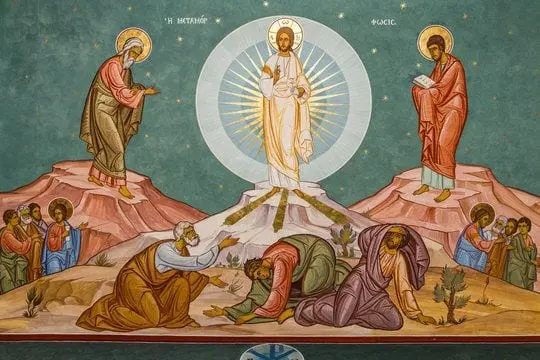
Consider the Transfiguration. Peter, James, and John were taken to a high mountain where they witnessed the Lord in His glory: "And was transfigured before them: and his face did shine as the sun, and his raiment was white as the light" (Matthew 17:2, KJV). They saw the uncreated light; they heard the very voice of the Father speaking from the cloud. One would assume that such a vision would render denial impossible. Yet only a short time later, in the courtyard of the High Priest, Peter denied the Lord three times. Despite having witnessed the Lord's glory, his conviction collapsed—because he had not coupled that vision with the ongoing discipline of nepsis and prayer. Vision does not equal conviction. The encounter with the God-state is a gift, but it does not naturalize the soul in God. Only the sustained labor of prayer can accomplish that.
This reveals what might be called the dilemma of the empty human being. Vision alone cannot fortify conviction against the articulate precision of satanic temptation. The human person, left to his own willpower, is incapable of resisting the intelligence of the demonic. This is precisely why Christ, in the shadow of the Cross, commanded the Apostles with urgency: "Watch and pray, that ye enter not into temptation: the spirit indeed is willing, but the flesh is weak" (Matthew 26:41, KJV). The lifeline of the soul is not the memory of past glory, but the present discipline of watchfulness. Nepsis is the state of spiritual sobriety that allows the believer to recognize and resist the dragnet of the cosmos as it is being cast. Without the constant assistance of the Holy Spirit—accessed only through the instrumentality of prayer—even those who have seen the uncreated light remain susceptible to denial. Prayer is the means by which vision is integrated into the soul, transforming a temporary experience into an enduring state of being.
The warning here is vital: we cannot live on the fumes of yesterday's encounters. Without prayer, we are hollow, regardless of our past spiritual highs. We must receive grace and assistance from the Holy Spirit daily to remain faithful. Prayer is the instrumentality through which God frames the life that must be lived in a world shaped in Satan's image. Having understood the inadequacy of vision alone, we turn now to the practical discipline of watchfulness—the act of turning to the wall to seek the Unseen.
Skopaleo: Looking into the Unseen via the Hezekian Model
True prayer requires a radical and intentional reorientation of the spiritual gaze. This is captured in the concept of skopaleo—the act of looking intently at that which is unseen, of fixing one's focus upon the invisible. This is not a passive glance but a concentrated, athletic effort of the nousNousThe faculty by which the human person perceives God. Healed, it sees; darkened, it wanders., the inner eye of the soul.
The model is perfectly illustrated in the account of King Hezekiah. When the prophet Isaiah delivered the divine pronouncement of his impending death, Hezekiah neither argued with the messenger nor consulted the physicians. His response was immediate and profoundly theological: "Then Hezekiah turned his face toward the wall, and prayed unto the LORD" (Isaiah 38:2, KJV).
The allegory of the wall captures the essence of true prayer. To turn one's face to the wall is to turn away from the seen—from messengers of doom, from medical reports, from financial crises, and even from the faces of loved ones—toward what appears to the world to be nothingness, but which is in reality the fullness of the invisible God. Prayer is the window through which the soul looks past the temporal horizon into the eternal. Hezekiah turned and looked into the invisible, and in doing so he accessed a reality that superseded the temporal decree of his own death.
This reorientation is essential because, as Paul reminds us, only the eternal possesses the power to alter the temporal: "While we look not at the things which are seen, but at the things which are not seen: for the things which are seen are temporal; but the things which are not seen are eternal" (2 Corinthians 4:18, KJV). The problems we face are located in the realm of the seen, but their solutions exist exclusively in the unseen. Hezekiah's willingness to turn from the visible reality of his death sentence allowed him to access the eternal decree of God, which subsequently changed the temporal outcome. Prayer is the mechanism of this exchange—the process by which we denaturalize the soul from the seen world and naturalize it in the presence of the Almighty. Man shall not live by bread alone, but by every word—every unseen substance—that proceeds from the mouth of God. Having turned to the wall, the believer must now navigate the interior battlefield of the mind.
Tactical Asceticism: Navigating the Dungeon of Thoughts (Logismoi)
Once the believer has committed to the vigil and turned their face to the wall, a new and more intimate battlefield emerges: the mind. The war in man is fundamentally a war of the will, and it manifests most persistently through the intrusion of logismoiLogismoiThe subtle movements that approach the soul uninvited, to be discerned at the door before they become passions.—vile, distracting, and discouraging thoughts. The spiritual life is not a linear ascent; it is a progression through a dungeon before one reaches the palace of communion. These thoughts are strategically deployed by the demonic to depower the warrior, and they are calculating in their method, targeting each believer's particular vulnerabilities—whether anger, lust, or a crushing sense of unworthiness and shame.
The adversary's primary tactic is to make the believer feel so spiritually contaminated that they abandon the altar altogether. He whispers that you are a hypocrite, a sinner, or that God is not listening. But these logismoi are, in truth, the screeching of the bound sacrifice. They are evidence that you are drawing near to the veil. The believer's weapon in this interior battle is the Name of Jesus: "That at the name of Jesus every knee should bow, of things in heaven, and things in earth, and things under the earth" (Philippians 2:10, KJV). Every thought—human, angelic, or satanic—is mandated to bow at that Name. When the noise from the sacrificed flesh becomes deafening, the Name must be wielded as a weapon, forcing those thoughts into submission.
This process bears comparison to a surgical operation. In the place of prayer, the Holy Spirit begins a precise and patient work, removing the spiritual accumulations that blind the eye of the soul. The sincere contrition of a broken heart is among the most potent forces in the spiritual universe; it dispels the demonic and undoes their strategic frameworks. The essential requirement is endurance. A warrior may be wounded in battle, but he must prevail. The feeling of unworthiness is not a disqualification. Christ did not come for the righteous, but to seek and save that which was lost. Our unworthiness is, in fact, our greatest claim upon His grace. By refusing to attend to the noise and remaining fixed on the Unseen, the believer moves through the dungeon of the flesh and into the liberty of the palace of the Holy Spirit.
The Gateway to Life and the Enduring Significance of the Vigil
The entire theological architecture of the Unseen Altar culminates in a single recognition: prayer is the gateway to Life itself. Christ's commands—to pray, to fast, to watch—are not burdensome, legalistic requirements. They are the very vehicles of Life. When we choose prayer, we choose to reject the thief who comes only to steal, kill, and destroy. We choose to align ourselves with the One who came "that they might have life, and that they might have it more abundantly" (John 10:10, KJV).
Prayer is the denaturalizing of the soul from a world made in Satan's image and its naturalization in the Kingdom of God. This requires a committed, sustained engagement with the athletics of eternity. The practice of the three-hour vigil is not an arbitrary duration; it is a strategic exercise in forcing the soul past its material constraints. The deliberate choice of an uncomfortable posture—kneeling beside a bed, sitting on an unyielding stool—ensures that the body remains a living sacrifice, and it kills the switch of the flesh so that the spirit may breathe.
The final realization is this: to choose prayer is to choose Life in its most fundamental and ontological sense. While the body may cry out from the fire of the altar, the soul finds its only true satisfaction in the uncreated light of the Father. The vigil is the house of God and the gateway into heaven, where the ladder of Christ connects the bridge of the soul to its eternal Source. As we offer our bodies and souls to God, we move from the temporality of bread to the eternity of the Word.
In the silence of the night, when the face is turned to the wall and the flesh is bound to the horns of the altar, the warrior of prayer discovers that the light affliction of the present moment is working an eternal weight of glory. The fire that consumes the sacrifice is the same fire that illuminates the nous, demonstrating that in the economy of the Spirit, the only way to truly live is to first die upon the unseen altar. Through watchfulness and the discipline of the body, the soul at last finds its rest in the substance of the Uncreated—having crossed the bridge from the dust of the earth to the breath of the Almighty. May we therefore bind ourselves to the altar, for in that binding, we discover our only true and eternal freedom.