The Name of Jesus, The Nature of Salvation & the Ontological Transformation of Mankind
Introduction
Within much of contemporary Western Christianity, salvation has been quietly reduced to a forensic transaction — a legal status adjustment, a reassignment of religious membership — one that fails to touch the deepest seat of the human person. This is a grave error. Viewed through the lens of patristic and pneumatological theology, salvation is not a passive receipt of divine pardon. It is the comprehensive ontological restoration of the human person: the reversal of a fundamental existential decay that has permeated the very fiber of our being. To understand salvation rightly is to recognize it as the realignment of one's inner life from the disharmony of the fall back into symphonic resonance with the Divine life.
The central thesis of this essay is that salvation constitutes the synergistic reconciliation of the human will with the Divine nature. This reconciliation is made necessary by what we may call the "ontological breach" — an abyss opened by sin that rendered the human person fundamentally incompatible with God. The fall was not merely a moral lapse but an ontological depletion, a severance from the very source of life. The restoration of the human person follows a precise ascetic trajectory: it commences with the interior necessity of repentance — exemplified in the narratives of Luke 15 and the prayer of Psalm 51 — moves toward the dogmatic necessity of the Holy Trinity and the Incarnation, and finds its fulfillment in the synergistic operation of grace. Authentic theological reflection cannot remain a detached intellectual exercise; it must begin with the act of "coming to one's senses," a movement from the dark abyss of existence toward the center of the Father's house.
Reflections on Luke 15 and Psalm 51
To map the mechanics of ontological return, we must examine the biblical archetypes that frame the believer's interior life. These narratives are not merely historical records; they are templates for the soul's reorientation. Scripture calls us to a certain urgency of feeling regarding our eternal destiny — an urgency reached only through the searing honesty of genuine contrition.
The parable of the Prodigal Son (Luke 15:11–20) offers us the definition of repentance. After squandering his inheritance and descending into the squalor of the "far country," the son undergoes a pivotal interior shift. The scripture records it simply: "And when he came to himself" (Luke 15:17). Repentance is, at its core, a restoration of sanity. It is the recognition that to be absent from the Father is to be in a state of perishing — that the soul's present trajectory leads only to starvation and death. It is the acknowledgement that we have spent ourselves on husks which cannot nourish the divine image within us.
If Luke 15 provides the narrative arc of return, Psalm 51 provides the template for confession and the manual for interior purgation. David's cry is not a casual apology. It is a deep reckoning with an inherited and pervasive state of brokenness: "Behold, I was shapen in iniquity; and in sin did my mother conceive me" (Psalm 51:5). The necessity of acknowledging that "my sin is ever before me" (Psalm 51:3), and the plea for "truth in the inward parts" (Psalm 51:6), reveal that repentance must penetrate far beneath the surface of conscious behavior into the hidden depths of the heart. One who is inclined toward a hellish nature cannot deem himself fit for heaven; and so the seeker must first look honestly upon his own unworthiness, that God might lift him up.
These two texts together trace the common stages of authentic repentance. The first is awareness — a stark, conscious recognition of one's sinfulness and the soul's resulting hunger, a clear-eyed perception of how deep the ontological depletion runs. The second is movement: the existential decision to "arise and go," translating interior conviction into a concrete turn toward the Divine Source. The third is confession — the verbal and heart-centered surrender of self-justification: "Father, I have sinned against heaven, and before thee" (Luke 15:18). Without this breaking of the heart, theology remains a cold architecture of words rather than a living encounter with truth.
Dogmatic Absence in Western Christianity
In the pursuit of holiness, dogma is not a burden — it is a necessity. Dogma serves as the anchor of the ship, grounding the believer's mind, behavior, and spiritual perception in something solid and true. Without a firm theological foundation, the Christian life becomes untethered, drifting into the dangerous shallows of emotionalism and spiritual sensationalism.
A serious examination of contemporary Western Christianity reveals a profound dogmatic absence — a vacancy at the center where the Holy Trinity ought to reign as the governing reality of all life and worship. When the theological premises of the faith are neglected, the vacuum does not remain empty; it fills with spiritual callousness and moral complacency. The result is a form of Christianity that fails to produce holiness, one with no internal constraints against evil and no genuine convictions to separate the believer from the world. We witness a spirit of confusion in which preachers stand in pulpits with profanities on their lips, and congregations live lives indistinguishable from those around them, marked by schism, disunity, and idolatry. This is not the Spirit of truth who proceeds from the Father; it is a hellish nature that has been mislabeled as Christianity.
The consequences of this failure are profound. Without rigorous Trinitarian and Christological dogma, our anthropology — our understanding of what a human being is — becomes fundamentally distorted. If we do not understand the Trinity, we cannot understand ontology, and without a proper ontology, we cannot accurately diagnose the human condition or prescribe its cure. Western Christianity often reduces the faith to a social club or a system for acquiring prosperity, but neither of these addresses the actual reality of human corruption. A Christianity that does not constrain your evil, that does not transform your behavior, is not Christianity at all — and one who lives within it is not, in the truest and most serious sense, a Christian. The resulting condition is one of ontological death, where the transformative mark of the Spirit is absent, leaving the individual unfit for heaven despite all verbal profession.
Anthropology and the Triune Image: Man Created for Communion
To correct the modern crisis, we must return to a proper anthropology — one rooted firmly in the Imago Dei. This concept cannot be overstated: man's purpose is entirely defined by his origin.
In the pre-fall state, man was created as the crown jewel of the entire cosmos. Brought into being by the Holy Trinity — as evidenced by the Divine counsel, "Let us make man" — the human person was made after the image of the Trinity itself. Man was intended to be an icon of the material cosmos, the living channel through which the entire created order would receive the revelation of God. This is the scale of the human vocation: through man's communion with the Divine, the whole of physical creation was meant to experience the vision of God. Fellowship with the Divine was not a feature of human existence but its very oxygen.
An adversary, however, sought to disrupt this Divine purpose. As a created being, Satan cannot originate purpose; he can only oppose it through disruption and severance. The demonic strategy was to sever the communion between God and man — to render the crown jewel of creation compatible with darkness rather than with light. Through the fall, man entered the ontological breach, a condition of fundamental incompatibility with the Divine nature. This was not merely a moral error. It was a severance from the only life-giving Source, and it was so profound that man, fallen not as a beast but as a man, cannot bridge the gap from his own side. The repair requires a Divine initiative — a reaching of the Uncreated into the created — if it is to be accomplished at all.
The Mystery of the God-Man: Christology as the Basis for Salvation
The Incarnation of the LogosLogosThe eternal Word of God, through whom all things were made, who became flesh and dwelt among us (John 1:1–14). is the only adequate response to the problem of human death and sin. Because man cannot save himself, the Savior must be the God-man. The inner logic of this reality is clear and precise: the one who created man must be the one who saves him. The Word, who was present and active in the initial creation of the human person, assumed that same ontology — the same nature of being — without the contagion of sin, in order to bridge the ontological chasm from within.
It is important to make a distinction here between material prosperity and ontological transformation. Poverty is not primarily a spiritual problem but an educational and practical one — a matter of wisdom, not demonic oppression. Before the coming of Christ, men like Solomon were already building cities and accumulating vast wealth; they were prosperous by any measure, yet they remained ontologically dead and fundamentally incompatible with God. Christ did not come to provide what man already possessed in some measure — material goods or social standing — but to provide precisely what man could not attain on his own: deliverance from the nature of sin. Christianity is not a club for the prosperous; it is the resurrection institution for the dead.
The Name of Jesus stands at the center of this restoration. As the angel declared, "thou shalt call his name JESUS: for he shall save his people from their sins" (Matthew 1:21). The invocation of that Name is tied directly to the person it signifies and to the work he accomplished. The Name is not a formula but an access point — the point at which we touch the Person and the Divine power he embodies. Without this specific Christology, the word "salvation" becomes empty. Salvation is, at its root, the reunion of God and man through the destruction of the sin that caused the breach.
Understanding the Synergistic Operation of Grace, Human Will, and the Cross
The process of sanctification is not a unilateral Divine act but a synergistic one — a cooperation between the Divine will and the human will, in which grace is offered and the human person must genuinely receive and respond to it.
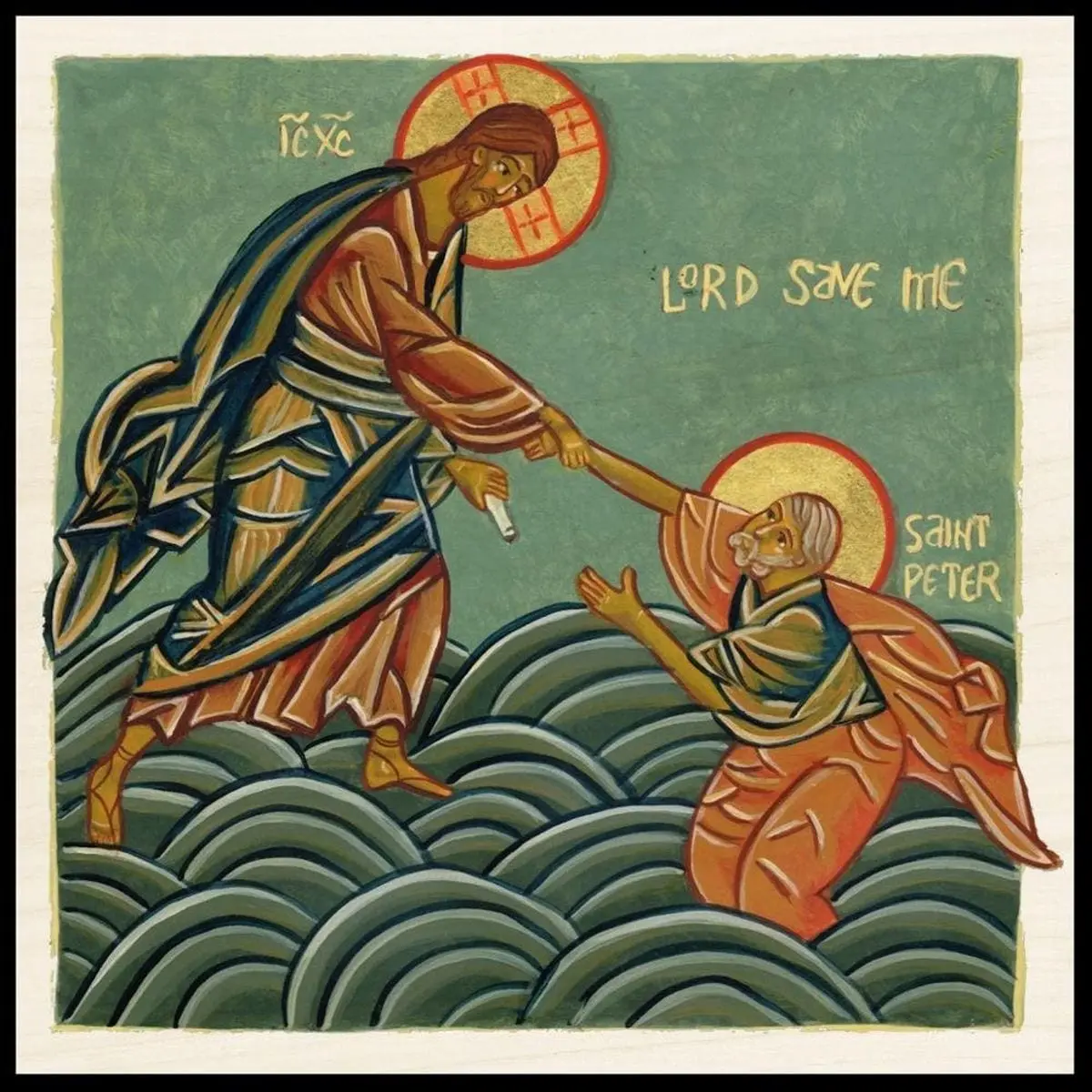
The Virgin Mary stands as the supreme dogmatic proof of this synergy. When the Holy Spirit proposed the Incarnation, it could not proceed until Mary gave her consent: "be it unto me according to thy word" (Luke 1:38). God will not save man without man's willing participation. This pattern appears throughout the Gospels: the two blind men who cried out for mercy, blind Bartimaeus who refused to be silenced by the crowd, and Peter who, sinking beneath the waves, cried out "Lord, save me." In every instance, the Divine power moved only when the human will reached toward it.
The ethical demands of this synergy are considerable. A Christological Christianity is not a passive arrangement but a rigorous way of life: one must deny oneself, carry one's cross, and uproot the passions. False versions of the faith inflate the self, but true salvation diminishes it — it directs all that energy toward the destruction of sin. If the flesh is not being mortified, the Spirit of God is being resisted. We are called not to a mere mouth-confession but to a transformative one. Christ secures the salvation; but the human person must actively yield to the operation of the Cross if the old man is genuinely to die.
Confronting the Beasts and the Passions
A life of theological seriousness requires the courage to look honestly into one's own heart. The heart of the unregenerate person may be rightly imagined as a jungle that feeds many beasts — the passions, the demonic inclinations, the hellish nature that inhabits the soul apart from grace, with Satan as the master of the thicket. There is a tragic absurdity in professing Christ while remaining unforgiving, unloving, wicked, or dishonest.
The sin of unforgiveness is among the most present and most dangerous obstacles to communion with God in our age. If one does not forgive, one is rendered unfit for heaven, for God will not forgive the one who harbors malice in his heart. To call Jesus Lord while the heart remains a habitat for pride and bitterness is a form of self-deception. The cry of Psalm 51 is the only adequate response to this condition: "Create in me a clean heart, O God; and renew a right spirit within me. Cast me not away from thy presence; and take not thy holy spirit from me. Restore unto me the joy of thy salvation; and uphold me with thy free spirit" (Psalm 51:10–12).
The believer must fight continuously to uproot the passions and put off the old man. Indifference to the purity of one's own heart is, in the end, indifference to God himself.
The Eternal Significance of Our Present Walk
This essay is a call for theological seriousness and genuine interior transformation. Salvation is an ontological pursuit that demands the total surrender of the human person to the light of Christ. We must reject the complacency of a faith emptied of dogma and return to the transformative reality of the God-man. Is what you possess truly the pearl of great price? If it were, we would spend our nights fighting off the beasts within and crying out for mercy.
The eternal gravity of this teaching must not be softened. It is possible to prophesy and to perform miracles in His name and still be numbered among those he does not know — the workers of lawlessness whom he will disown at the last day (Matthew 7:23). The warning is stark and sobering: if one does not mourn over sin in this life, the consequence is to mourn in the life to come without end.
The ultimate goal of this walk is that the light of life would shine upon the soul, drawing the believer out of the darkness of the world and into the sanctification of the Spirit. Salvation is nothing less than the restoration of our original purpose: to dwell in the presence of the Holy Trinity, transformed and made compatible with the Divine Nature through the grace of our Lord Jesus Christ. May he have mercy on our souls, and open our eyes to see the light and walk in it.
Further Reading
- Psalm 51:3 — "For I acknowledge my transgressions: and my sin is ever before me."
- Psalm 51:5 — "Behold, I was shapen in iniquity; and in sin did my mother conceive me."
- Psalm 51:6 — "Behold, thou desirest truth in the inward parts: and in the hidden part thou shalt make me to know wisdom."
- Psalm 51:10–12 — "Create in me a clean heart, O God; and renew a right spirit within me. Cast me not away from thy presence; and take not thy holy spirit from me. Restore unto me the joy of thy salvation; and uphold me with thy free spirit."
- Matthew 1:21 — "And she shall bring forth a son, and thou shalt call his name JESUS: for he shall save his people from their sins."
- Luke 1:38 — "And Mary said, Behold the handmaid of the Lord; be it unto me according to thy word. And the angel departed from her."
- Luke 15:17–18 — "And when he came to himself, he said... I will arise and go to my father, and will say unto him, Father, I have sinned against heaven, and before thee."