The Necessity of Ontological Transformation in Salvation
The Problem of Static Soteriology
A debilitating crisis has taken root within the Evangelical theological framework, particularly within the tradition I was raised under. At its heart is what we must name plainly: a static soteriology. This is the understanding of salvation as a fixed historical event, a legal transaction, or a one-time verbal confession that demands nothing further of the soul — no movement, no transformation, no becoming. In this reductionist view, the Kingdom of Heaven is a destination one reaches by signing a contract rather than a transfigured state of being one enters through genuine change. This is not merely a theological error. It is a hellish disaster, one that ignores the ontological reality of the human condition.
The central thesis of this essay is that salvation is an ontological necessity of transformation. It is an imperative, continual, and synergistic movement toward divine participation — the transition from the state of a son of hell to that of a son of light, made possible only through a radical change in the very nature of the human person, wrought by the redemptive work of the incarnated God. We must move beyond the Western obsession with forensic justification, where God is imagined as a judge graciously overlooking a criminal's record, and return to the ancient, therapeutic understanding of the Church as a hospital and haven for the ontologically sick. Salvation is the process of being saved from our sins, not merely from their punishment. If the mission of Jesus was to save his people from their sins (Matthew 1:21), then a life in which sin continues undisturbed suggests that the reality of salvation has not yet been realized in that believer.
This essay explores three indispensable pillars: the theology of repentance (MetanoiaMetanoiaA change of the nous: the whole self turning toward God, not once, but daily, through repentance and confession.), the sacrificial nature of the Eucharist, and the mandate for holiness through TheosisTheōsisNot that we become God by nature, but that by grace we are drawn into His life: “partakers of the divine nature” (2 Peter 1:4).. We will dismantle the Sola Fide narrative that has paralyzed the spiritual life of so many, and replace it with the biblical and patristic vision of synergy — the cooperation between Divine Grace and the human will. Our purpose is to map the geography of the heart, tracing the journey from interior brokenness to the liturgical climax of the Altar, and finally to participation in the Uncreated Life of the Trinity. This journey does not begin with a self-assured proclamation of saved status. It begins with the fundamental act of the lost soul being found through the mystery of repentance.
Repentance: The Means of Return
The initiation of ontological transformation is found in Metanoia — repentance. In the apostolic and Christocentric tradition, repentance is far more than a fleeting emotional state of remorse or a psychological burden of guilt. It is the essential mechanism of return: the ontological pivot by which the sinner ceases to be lost and becomes found. Without this foundational turning, the grace of Christ remains an external potentiality rather than an internal reality. Repentance is the door through which the soul enters the synergistic life. It is the recognition that the hopeless condition of sin — a state of ontological sickness — can only be rectified by a deliberate and total turning toward the Lord.
The Parable of the Lost Sheep (Luke 15) offers a sharp correction to popular, sentimental readings of this truth. While Western homiletics tends to dwell almost exclusively on the Shepherd's searching activity, the theological depth of the parable reveals something more precise. The joy in heaven is not triggered merely by the Shepherd's motion; it is triggered specifically by the repentance of the sinner. As the Scripture records: "I say unto you, that likewise joy shall be in heaven over one sinner that repenteth, more than over ninety and nine just persons, which need no repentance" (Luke 15:7). There is a cutting irony in the mention of those ninety and nine. In context — surrounded by murmuring Pharisees — this is a sarcastic rebuke. Those who do not regard themselves as sinners feel no need for the Physician and so remain entirely outside the scope of the Shepherd's joy. Unless one is broken by their lost condition, the mechanism of salvation cannot engage. Repentance is thus the very means by which we are found. It is the moment the prodigal ceases to wander in the far country of the passions and begins the ascent toward the Father's house.
This interior state of brokenness finds its most profound archetypal expression in the Davidic confession of Psalm 51. This is not merely a historical record of a monarch's moral failure; it is a universal liturgy for the human condition. To read Psalm 51 is to find yourself in your entirety — for as David is the iconic sinner, so are you, and he is you:
"Have mercy upon me, O God, according to thy lovingkindness: according unto the multitude of thy tender mercies blot out my transgressions. Wash me throughly from mine iniquity, and cleanse me from my sin. For I acknowledge my transgressions: and my sin is ever before me. Against thee, thee only, have I sinned, and done this evil in thy sight: that thou mightest be justified when thou speakest, and be clear when thou judgest. Behold, I was shapen in iniquity; and in sin did my mother conceive me. Behold, thou desireth truth in the inward parts: and in the hidden part thou shalt make me to know wisdom. Purge me with hyssop, and I shall be clean: wash me, and I shall be whiter than snow. Make me to hear joy and gladness; that the bones which thou hast broken may rejoice. Hide thy face from my sins, and blot out all mine iniquities. Create in me a clean heart, O God; and renew a right spirit within me. Cast me not away from thy presence; and take not thy holy spirit from me. Restore unto me the joy of salvation; and uphold me with thy free spirit." (Psalm 51:1–12)
This cry reveals that the sacrifice God truly requires is a broken spirit — a broken and a contrite heart, O God, thou wilt not despise (Psalm 51:17). This brokenness is a spiritual prerequisite because it creates the interior hollow necessary for divine grace to operate. The soul must recognize its infirmity before it can seek the Great Physician. When the Psalmist confesses that he was shapen in iniquity, he is admitting that his problem is not merely what he does, but what he is apart from God. This interior, private act of confession and repentance is the essential preparation for the believer to move into the communal, external, liturgical act of the Eucharist. The broken bones of the sinner are healed only through the broken body of the Lord upon the Altar.
The Eucharist is the Central Sacrifice of Worship
A significant and dangerous divergence exists between the modern Western understanding of worship and its ancient, biblical reality. In much of the contemporary West, worship has been reduced to an aesthetic or emotional experience — primarily the singing of songs to a deity in a manner that increasingly mimics secular entertainment. But history, patristic theology, and Holy Scripture are unanimous: worship is fundamentally synonymous with sacrifice. One cannot truly worship without rendering to the deity that which is of worth-ship — an offering demanded for fellowship or the appeasement of justice.
The historical mandate of the priesthood, established through the Hebraic tradition, confirms this inseparable link. As recorded in the account of Elkanah: "And this man went up out of his city yearly to worship and to sacrifice unto the Lord of hosts in Shiloh" (1 Samuel 1:3). In the ancient mind, to go to worship was to go to sacrifice. The Tabernacle in the wilderness was not a lecture hall for sermons; it was a sanctuary of slaughter and smoke. And it was built as an icon — a sacred image — of the heavenly sanctuary. God's instruction to Moses to construct it according to the pattern shown on the mount (Exodus 25:40) established the liturgical principle that the earthly mirrors the divine. The Tabernacle was the shadow; the sacrifice was the substance that allowed man to approach the Holy without being consumed. The mandate that one must not come before the Lord empty-handed meant simply this: bring a sacrifice.
In the New Covenant, Christ fulfills this entire liturgical archetype. He is simultaneously the High Priest and the Victim. The shadows of the Old Testament find their Real Presence in Him. Consequently, the Eucharist is the liturgical climax and the pulsating life of the Church. We do not gather around a pulpit or a personality; we congregate around the Altar of the Sacrifice. A merely symbolic or representative interpretation of the Eucharist must be firmly rejected. If the Eucharist is only a symbol, it possesses no power to effect ontological change. But because it is the real body and the real blood, it becomes the theotherapeutic medicine for the remission of sins.
"And as they were eating, Jesus took bread, and blessed it, and brake it, and gave it to the disciples, and said, Take, eat; this is my body. And he took the cup, and gave thanks, and gave it to them, saying, Drink ye all of it; For this is my blood of the new testament, which is shed for many for the remission of sins." (Matthew 26:26–28)
The Eucharist is the mechanism by which the life of Christ is perpetuated in the body of the Church. This connects directly to the Passover context of the Exodus. Just as the Passover was a remembrance (anamnesis) that brought the historical act of deliverance into the present reality of its participants, the Eucharist brings the sacrifice of Golgotha into the now of the believer. It is the memorial that insists upon the present reality of God's power. Without sacramental participation, the soul risks spiritual atrophy. Christ's words are absolute: "Except ye eat the flesh of the Son of man, and drink his blood, ye have no life in you" (John 6:53). This is ontological divinity being offered to ontological sickness. And this liturgical altar, where we offer back to God the sacrifice He has given us, necessarily calls forth a corresponding transformation in the altar of the heart — leading the believer from the communal act of communion toward the personal labor of holiness.
Static Confession vs Salvation as Movement
If the Eucharist is the lifeblood of the Church, then salvation must be understood as a continual movement toward the Divine rather than a static state or a one-time event. The danger of the one-time confession model is that it produces a false sense of security — a claimed saved status that bears no moral or ontological fruit. This is precisely the hypocrisy that John the Baptist and our Lord repeatedly rebuked. To declare oneself saved while remaining a prisoner of the passions is a profound spiritual delusion.
Consider the allegory of the saved thief or liar. If a man confesses Jesus is Lord but continues to live as a serial liar, a hijacker, or a murderer, where does his saved status actually reside? If the destiny of Jesus was to save his people from their sins (Matthew 1:21), and that person continues in sin, then Christ has not yet fulfilled His destiny in that individual. Salvation is not a legal fiction in which God declares a son of hell to be a resident of heaven while his heart remains, as it were, a zoo of ungoverned passions.
Our Lord provides a terrifying criterion for the Kingdom in the Gospel of Matthew: "Not every one that saith unto me, Lord, Lord, shall enter into the kingdom of heaven; but he that doeth the will of my Father which is in heaven. Many will say to me in that day, Lord, Lord, have we not prophesied in thy name? and in thy name have cast out devils? and in thy name done many wonderful works? And then will I profess unto them, I never knew you: depart from me, ye that work iniquity." (Matthew 7:21–23)
This passage reveals that verbal profession and even dramatic charismatic works are entirely insufficient if the fruit of a life does not correspond to the confession. The Lord, Lord declaration lacks what we might call the spirit of faith — which is action. Even demons possess a form of belief; they believe and tremble (James 2:19), yet they are not saved because they do not do the will of the Father. Salvation therefore cannot be confined to a static historical moment. It is a continuous personal endeavor that must be worked out with fear and trembling (Philippians 2:12).
To lay this distinction bare: static, legalistic salvation treats the redemptive act as a one-time forensic transaction whose primary concern is legal status and the avoidance of punishment. It is driven by Monergism — God working alone upon a passive human subject — and its only evidence is a past profession of faith. Sin, in this framework, is a legal debt to be cleared. Ontological, transformative salvation, by contrast, understands redemption as a continual movement and mystical participation. Its primary concern is the actual change of nature, the holistic healing of the person. It is synergistic — requiring the cooperation of Divine Grace and the human will — and its evidence is the present fruit of a life pursued in holiness. Sin, here, is an ontological sickness to be healed, not merely a charge to be dismissed. The scriptural grounding for this vision is found throughout: Matthew 7:21–23; James 2:24; Hebrews 12:14. If salvation is not static, it must be synergistic — a cooperative work between the grace of God and the labor of the human will.
Synergistic Operation: Faith Perfected by Works
The concept of synergy — synergeia, or working together — is central to the ontological path. It is the cooperation between Divine Grace, the unmerited power of God, and the deliberate labor of the human will. This theological reality is most explicitly articulated in the Epistle of James, which directly confronts the Sola Fide narrative of Western Reformation circles. James asserts a foundational truth without apology: "faith without works is dead, being alone" (James 2:17).
To explain this relationship, he draws on a radical and illuminating metaphor — the body and the spirit: "For as the body without the spirit is dead, so faith without works is dead also" (James 2:26). In a striking inversion of common Western assumptions, James here identifies works as the spirit of faith. Faith is the body — the structure, the confession, the form. But works provide the breath, the life, the animation. Just as a body without a spirit is a corpse — inanimate, cold, and decomposing — faith without works is a theological corpse. It is the works, the fruits, that justify the faith, for it is in the doing that belief is substantiated and made visible. This is why the ancient Church Fathers saw no genuine conflict between Paul's emphasis on grace and James's emphasis on works. They understood that the life of faith is the works.
The examples of Abraham and Rahab demonstrate that justification is the result of faith wrought together with works. "Was not Abraham our father justified by works, when he had offered Isaac his son upon the altar? Seest thou how faith wrought with his works, and by works was faith made perfect? ... Ye see then how that by works a man is justified, and not by faith only." (James 2:21–24) Abraham's faith was made perfect — brought to its telos, its end and fulfillment — only when he climbed the mountain and drew the knife. Salvation is therefore a personal work, not in the sense that man saves himself by his own power, but in the sense that man must labor toward the reception of grace. Although Christ has wiped away the guilt of Adam, the consequences of sin — the corrupted nature — must be undone through the synergy of grace and effort. This labor manifests as interior warfare against the passions that separate man from the Uncreated Light.
Noetic Warfare: Nepsis, Passions, and the Guarding of the Heart
The synergistic life is characterized by an ongoing interior struggle. This warfare is not waged against external enemies, but against the passions — those internal distortions of the soul such as pride, vainglory, gluttony, and lust — that obscure the divine image within us. To navigate this terrain, the believer must practice NepsisNēpsisSobriety of soul: the guarding of the heart by which a life is brought under the governance of the Spirit., or watchfulness. In the Hesychastic tradition, Nepsis is the constant guarding of the heart against the prosbole — the initial assault of a thought — before it develops into a full-blown passion or sin.
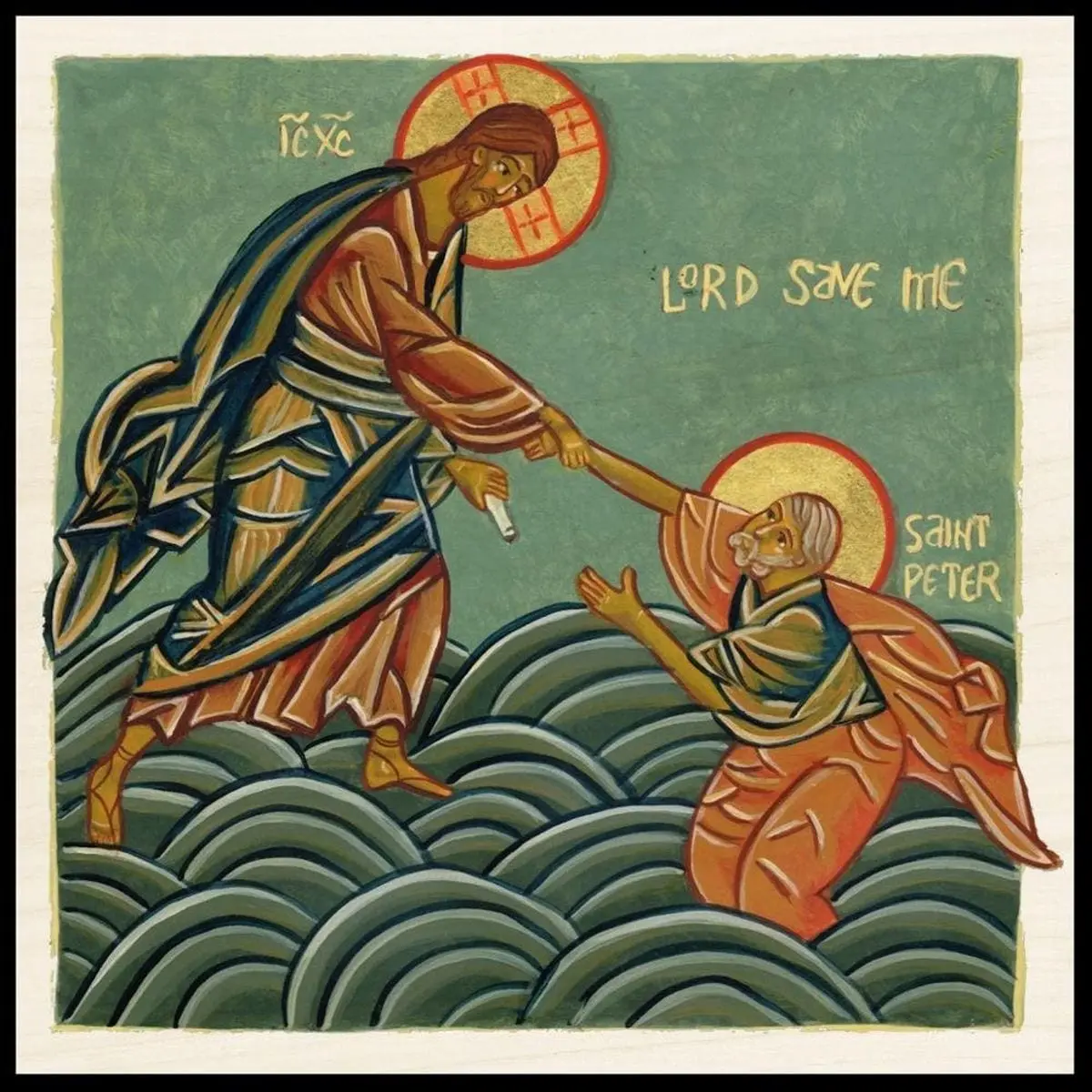
The failure of Peter in the Garden of Gethsemane is a critical case study in the collapse of confession without watchfulness. Peter had made a bold declaration, promising to die with Jesus. Yet when the hour of testing arrived, he lacked the interior strength to stand — because he had not watched. "Watch and pray, that ye enter not into temptation: the spirit indeed is willing, but the flesh is weak" (Matthew 26:41). Because Peter slept, he fell. His confession was not enough to sustain him, because it was not adorned with the work of Nepsis.
The landscape of the heart is dangerous terrain. The heart is like a zoo, and the beasts within it cry out — these are the passions, the thieves of the night that stalk across its surface. Behind every vicious thought, every movement of bitterness, every temptation, hell itself is reaching for the word that has been sown. Holiness, rightly understood, is not mere moralism; it is ontological health. It is the process of being cleansed, purified, sanctified. The Name of Jesus serves as the therapeutic instrument in this warfare — the strong tower into which the righteous run and are saved (Proverbs 18:10). Just as Jesus healed the blind, the lepers, and the dead, demonstrating that humanity is ontologically sick, His Name continues to heal the multitude of sicknesses within the human heart. Christianity without Nepsis and holiness is a hollow shell — and this purification is the indispensable prerequisite for the ultimate end of the human person: Theosis.
Theosis: Participation in the Divine Nature
The chief will of God for mankind is the return of sons to the Father through the process of Theosis — the becoming like Christ, the restoration of the divine image and likeness distorted by the Fall. To understand why this restoration is necessary, one must grasp what we might call the compatibility of image. For communion to exist, there must be a shared nature.
In the Genesis account, Adam was presented with the beasts of the field to name, but "for Adam there was not found an help meet for him" (Genesis 2:20). The ontological reason for this incompatibility is profound: the animals were not made in the image of God. Only that which bears the divine image is compatible for communion with the Divine. God cannot commune with the animal kingdom — not as an insult to creation, but as a simple ontological statement. God can only commune with that which is made in His image, and only man bears the image of the Uncreated God.
Through sin, man lost his likeness to God, becoming incompatible with the Holy. Darkness cannot commune with Light; Belial cannot commune with Christ. The Incarnation is the divine mechanism for restoring this compatibility. Christ, the Theanthropos — the God-Man — takes on the image of man, appearing in the likeness of sinful flesh (Romans 8:3), yet without sin. He assumes our nature precisely to undo the ontological sickness and transform us from ontological sin to ontological divinity. By assuming what is ours, He gives us what is His.
The goal of this transformation is Theoria — the vision of God — promised only to those who achieve interior purity: "Blessed are the pure in heart: for they shall see God" (Matthew 5:8). This seeing is not an external sight but an internal realization of the indwelling of the LogosLogosThe eternal Word of God, through whom all things were made, who became flesh and dwelt among us (John 1:1–14).. It is the result of the eradication of the passions and sins that cloud the inner eye. Theosis is participation in the very life of God. Salvation is the means to this end, and that end is eternal participation in the life of the Holy Trinity. Without ontological transformation, one cannot truly be saved, for heaven cannot house those who remain citizens of hell in their nature. We must be sanctified — undergoing the work of the Spirit until we can resist sin, as the Scripture commands, even unto bloodshed.
The Eternal Mandate for Transformation
The journey of salvation is a rigorous and narrow path, moving from the broken and contrite heart of repentance to the Uncreated Light of Theosis. A profession of faith without a life of holiness is a hellish disaster — a hollow declaration that fails entirely to engage the synergistic reality of the Christian life. The Eucharist, the practice of repentance, and the disciplined labor of the will are the three pillars that support the bridge across the chasm of our fallen nature.
We must not be deceived by the static soteriology of our age. To be saved is to be healed. To be a Christian is to be a warrior against the beasts of the heart's zoo. It is the hardest thing any of us will ever attempt — yet it is made possible by the grace of our Lord Jesus meeting our effort precisely at the point of our infirmity. This is my constant cry, and I hope it becomes yours too:
Look upon me with pity, for I am weak. I am infirmed. I am a sinner. Assist me by your grace, that I might be called son of God, son of light in a dark and perverse world. I pray that you save us from our sins. I pray that you give us grace to labor in salvation.
The eternal mandate is clear and absolute: "Follow peace with all men, and holiness, without which no man shall see the Lord" (Hebrews 12:14). This pursuit is not optional. It is the ontological necessity of our existence — the call to move from the darkness of our passions into the garden of divine fellowship, transformed by the Presence of the One who is the Way, the Truth, and the Life. Only through this transfiguration do we fulfill the chief will of God: that we might be saved from our sins and returned, as sons, to our Father. We offer back to Him the sacrifice He has given us, until the Uncreated Light consumes the darkness of our nature, and we are made whole in Him.