Proximity to God: The True Measure of Value
The Immaterial Soul
Our age is afflicted by what can only be described as a great pandemic of mental and spiritual instability. This malaise is not simply a clinical condition or a byproduct of late-modern life; at its deepest level, it is an ontological crisis — a crisis of being. It manifests as a fragmentation of the NousNousThe faculty by which the human person perceives God. Healed, it sees; darkened, it wanders., the eye of the soul, which has grown clouded through the relentless pursuit of the transitory. When the interior life loses its orientation, the human person descends into a pervasive despondency and lack of spiritual direction — the condition the Desert Fathers called acedia. This crisis arises from a failure to recognize the soul's true situation: that it inhabits the material world as a temporary dwelling place, not a final destination. For a human life to achieve genuine stability — mental, spiritual, or natural — it must be lived from the right foundation, anchored in the understanding that human value derives exclusively from the soul's proximity to God, not from the accumulation of material goods.
The soul, in its primary nature, is an immaterial substance. Its origins are not in the dust of the earth but are, as the Patristic tradition affirms, Pneumaticos — spiritual and divine in its calling. Though it resides within a material habitat, the soul's true home belongs to a non-material, noetic order of reality. When it attempts to establish its worth or secure its existence through the possession of physical things, it undergoes a process of erosion. This is precisely the warning our Lord issues: "Take heed, and beware of covetousness: for a man's life consisteth not in the abundance of the things which he possesseth" (Luke 12:15). Covetousness is far more than a moral failing; it is a spiritual disease that bends the soul's trajectory away from its ultimate Teleology, which is the hosting of the Divine Presence. This misalignment typically takes root in philautia, or self-love, which attempts to fill the soul's infinite hunger with finite things — and so produces the noetic blindness that characterizes the modern condition.
To address this disorientation, a profound reorientation of perception is required: a movement away from a transactional view of the divine and toward an ontological one. The architecture of a stable life begins with the difficult discipline of accepting the Divine Will — a movement from the will of petition to the will of acceptance. This essay traces the structure of that reorientation. We begin with the Davidic model of acceptance, where surrender to divine sovereignty prevents the soul from sinking into despair. We then examine the crisis of valuation that defines our world, contrasting the so-called "Sangoma" approach to God with the true hosting of the LogosLogosThe eternal Word of God, through whom all things were made, who became flesh and dwelt among us (John 1:1–14).. From there we explore the soul's chief mission as an interior tabernacle, the synergistic cooperation between human effort and divine grace, the regulatory power of Agape, and the strategic necessity of the Church's sacramental order — the Bishop and the Eucharist. Ultimately, the path to stability leads toward the immortalization of man: a journey culminating in the resurrection and eternal communion with the Triune God.
Davidic Model of Acceptance: Repentance and the Sovereignty of God
The account of King David following his transgression against Uriah and Bathsheba provides the foundational case study for noetic reorientation. When the Prophet Nathan delivered the divine judgment — that the child born of this union would die — David entered a period of intense spiritual and physical labor. He fasted, wept, and lay prostrate upon the earth for seven days in an act of profound petition. Yet when the child died, something remarkable happened. David arose, washed, anointed himself, changed his garments, and entered the house of the Lord to worship (2 Samuel 12:20). This was no act of callousness. It was a demonstration of what we might call the "Davidic Pivot" — a movement of strategic surrender to the sovereign Thelema, the will of God. David moved from laboring to change God's mind to the far harder labor of aligning his own mind with God's manifest decree.
For the contemporary believer, this model is indispensable. It guards against the paralysis of despondency that follows personal failure or unfulfilled expectation. David understood that while the child lived, petition had its proper arena; once the divine decree had been made manifest in death, that arena shifted to acceptance. He expressed this with striking clarity: "But now he is dead, wherefore should I fast? can I bring him back again? I shall go to him, but he shall not return to me" (2 Samuel 12:23). In Patristic psychology, this is the restoration of the garment of light — the re-alignment of the human will with the Divine Will. Many souls today remain fractured precisely because they cling to what is "dead": past mistakes, lost relationships, failed ambitions. Refusing to let go, they deviate from the path of life and invite the fragmentation of the nous.
The theological concept underlying this acceptance is that of permitted suffering. In the economy of God, nothing occurs without the permission of the Almighty. Though our own sins frequently bring painful consequences, the soul must learn to bear those consequences with contrition rather than despair. David confessed, "I have sinned against the Lord" (2 Samuel 12:13), yet he refused to allow his guilt to harden into a terminal depression. He understood that even within what the tradition calls "ill occurrences," God is able to perfect the soul's journey. This is the mystery of Providence: that God uses both our failures and the permitted sufferings of this life to prune the soul for greater fruitfulness. Acceptance is the only mechanism by which spiritual progression becomes possible. Without it, the soul remains locked in mourning for a past it cannot change, rather than moving toward the future God has prepared. The interior stability born of this surrender then equips the believer to anchor their sense of value in the definition of life that Christ himself provides.
True Value: Luke 12 and the Erosion of the Soul
In the contemporary world, a human life is most commonly measured by economic metaphors and material accumulation. This is the manifestation of what we might call the Laodicean Trap — the condition of the soul that boasts, "I am rich, and increased with goods, and have need of nothing," while remaining blind to the reality that it is "wretched, and miserable, and poor, and blind, and naked" (Revelation 3:17). Christ employs these very metaphors to expose the spiritual poverty of a life defined by the material. He identifies covetousness — the uncontrollable desire to possess more than one is allotted — as the great eroder of the soul. This lust transforms the spiritual life into a transactional pursuit of material fortune, treating the Almighty not as the Life-giver but as a kind of divine provider of luck and material security — what, in the Southern African context, might be called the "Sangoma" function. When God is approached through this lens, the entire spiritual framework becomes carnal, and the soul's value is wrongly measured by the abundance of things possessed.
Material valuation of the soul operates by inflating the ego through possession. It proposes that a person's worth is determined by material outcomes — status, wealth, and influence. In doing so, it creates a deep noetic blindness in which material wealth masks an underlying ontological poverty. Possessions offer a counterfeit security that prevents the soul from seeking the true substance of its existence. Divine valuation, by contrast, locates worth in the soul's proximity to God — the greatest immaterial possession a human being can attain. The value of a life is measured by how fully the soul hosts the Logos. Because the soul was created for communion with God, its health and vitality are directly proportional to its closeness to the Father. This wealth is entirely independent of material success, as the Lord's question makes clear: "For what shall it profit a man, if he shall gain the whole world, and lose his own soul?" (Mark 8:36). To possess God is to possess everything, even where the world is lost.
The "Sangoma" mentality is a parasitic approach to the divine — one in which prayer and worship function as currency used to purchase material favor. This stands in direct opposition to the Patristic understanding of the soul's journey. God is not the dispenser of blessings to be invoked and dismissed; He is the very sustenance and vitality of all beings. If we define our lives by what we have or do not have, we remain perpetually vulnerable to every fluctuation of the material world. But if we anchor our value in the hosting of the Divine Presence, we attain a stability that no earthly circumstance can disturb. The mission of the soul is not to amass what is transitory but to become a vessel for what is eternal. This transition — from material possession to divine hosting — is the critical movement of the spiritual life, and it demands that the soul be redirected toward its chief mission.
The Chief Mission of the Soul: Hosting the Logos and the Anatomy of Communion
The human soul is an interior tabernacle — a sanctuary fashioned to host the Divine Presence. This is its chief mission and its highest honor. The mission is not fulfilled through external religious observance alone but through a deeply personal, interior revelation of God. While there is a general Theophany made manifest through creation and through the historical person of Jesus Christ, there is also a profoundly intimate revelation that occurs within the depths of the individual soul. This is the interiority of revelation — the movement beyond mere intellectual knowledge of God toward a state of direct, noetic knowing, in which the Logos, the principle of all life and reason, takes up residence within the human person and illuminates the darkness of the fallen nature.
This personal revelation depends entirely upon the sovereign will of God. As the Lord himself declared, no man knows the Father except the Son, and he to whom the Son wills to reveal Him. This renders the revelation priceless — it cannot be earned or purchased; it is a gift of divine grace to the seeking soul. The life of the Apostle Paul on the road to Damascus illustrates this with force. His companions felt the impact of the light and heard a sound, yet only Paul was interiorly transformed by the personal revelation of the Christ he had been persecuting. Likewise, the Prophet Daniel, through diligent seeking and prayer, remained standing to behold a vision while his companions fled in terror. Both accounts demonstrate that the indwelling of the Logos is the only thing that gives a spiritual vision or experience its true value. Without the Word dwelling within, spiritual experiences remain at the level of psychological phenomena; with the Logos, they become the very substance of life.
The promise of this interior hosting is given plainly by Christ: "If a man love me, he will keep my words: and my Father will love him, and we will come unto him, and make our abode with him" (John 14:23). This "abode" is the ultimate state of proximity — the indwelling of the Father and the Son through the Holy Spirit. To host God in this manner is to be truly enriched, for the presence of God carries within it a vitality that causes every other dimension of life to flourish. Yet this hosting is not a passive state. It requires a constant, active alignment of the human will with the Divine Will — a "knitting" of the soul to the Lord that demands what the tradition calls Synergia: the ongoing cooperation between the Creator and the creature.
The Synergistic Path: Ancient Landmarks and the Fruitfulness of Abiding
The realization of the soul's mission requires Synergia — the cooperation between human will and divine grace. God is the source of all life and revelation, but the human person must bring the effort of pursuit. This is not a works-based salvation but a responsive communion. Throughout the Scriptures, communion with the Divine is consistently preceded by human exertion — what the Fathers called the labor of the heart. Moses climbed the mountain; Abraham presented himself before the Lord; Elijah stood upon the mount before the Almighty's presence passed. There is a profound distinction between wanting what communion gives and actually having communed. Many seek the fruits of the spiritual life — joy, peace, abundance — without engaging in the labor that produces the communion from which those fruits naturally flow.
The imagery of the Rod of Aaron and the Vine and Branches illuminates this reality. In the wilderness, the Rod of Aaron was distinguished from the rods of the other tribes by a single quality: when placed before the Ark of the Covenant, it budded, blossomed, and bore almonds (Numbers 17:8). A life brought into alignment with the presence of God cannot remain barren; fruitfulness is the natural consequence of divine proximity. The presence of God acts as a catalyst for the soul's latent potential, awakening what had lain dormant. Christ's own teaching deepens this picture: He is the vine and we are the branches, and a branch cannot bear fruit of itself unless it abides in the vine. The evidence of a soul truly abiding in God is found in the spiritual Energeia that flows through the person — a continuous fruitfulness in virtue, a fullness of joy that persists through external difficulty (Psalm 16:11), and a noetic peace that stabilizes the mind against circumstance.
Where life appears fruitless or empty, the soul must exercise what we might call the integrity of the question. Rather than casting blame upon the character of God — "Does God not care?" — the individual must turn inward and ask honestly: Have I sought His kingdom? Have I walked in righteousness? Have I fulfilled the commandments? Frustration in the spiritual life typically arises when we expect the rewards of the covenant without having met the conditions of the commandment. Seeking the kingdom first is the only way to ensure that the other things of life are properly ordered and added in their due time. This synergistic effort is ultimately governed and harmonized by the greatest of all commandments — the love that directs the entire human being back toward its divine source.
The Chief Regulator: Loving God with the Entirety of Being
Agape — love — is the bond of being and the chief administrator of human life. It is not a sentiment or a fleeting emotion but a commandment of the will that harmonizes all the faculties of the human person into a unified whole. The Lord identifies the greatest commandment as: "Thou shalt love the Lord thy God with all thy heart, and with all thy soul, and with all thy strength, and with all thy mind" (Luke 10:27). The scope of this commandment encompasses the entirety of the person — the heart as the center of desire, the soul as the seat of life, the strength as the energy of the body, and the mind as the faculty of reason. When love for God becomes the governing force of a life, the human person is "fitly joined together and compacted," achieving an interior harmony that prevents the fragmentation of the self.
This love is essentially sacrificial in nature. It involves Kenosis — the self-emptying of the individual will — expressed concretely in the keeping of the Logos, which frequently demands the crushing of self-will and the subjugation of the sin-dominated nature. To love God is to choose His will above one's own desires, exercising the will toward love as a deliberate, daily act. The arenas in which this love is demonstrated are practical and often demanding: taming the tongue, loving enemies, maintaining silence in the face of persecution. This sacrificial love is the only power capable of overcoming the world and its lusts. Without it, the human person remains disjointed — scattered across a multitude of competing desires and anxieties, with no single organizing center. Love is the chief regulator because it directs all the energy of the being toward the one thing needful: the glory of God.
In this struggle, the believer looks to Christ as the Imitatio Christi — the icon of human perfection. Christ is the model of how to love the Father with the fullness of one's being. He was tempted in all points as we are, yet remained without sin because there was no ontological deficiency — no fault — within Him. Human beings sin because of a fundamental fault in their nature, a propensity toward the self that Scripture calls the fallen condition. But by beholding the sinless Christ as our physician and defender, we are gradually conformed to His image. This transformation is not an individualistic endeavor. It is nourished and sustained through the communal and sacramental life of the Church, where the individual's interior love for God is anchored within a visible, ordered body.
Ecclesiastical Anchor: The Bishop, the Eucharist, and the Incarnation
The path of the soul is not a solitary one. It is anchored in the strategic necessity of the Church's hierarchy and sacraments — what we may call the Ignatian mandate. St. Ignatius of Antioch exhorted the faithful plainly: "Let nothing be done without the bishop." The Bishop is not merely an administrative figure; he is the icon of Christ within the congregation and the guardian of its ancient landmarks. The danger of disregarding this order is illustrated in the example of King Saul, who, in his impatience, took it upon himself to offer the sacrifice rather than waiting for the Prophet Samuel. This breach of order marked the beginning of Saul's undoing, demonstrating that spiritual progress requires submission to divine hierarchy. The contrasting figure is Abel, who offered a more excellent sacrifice precisely through faith and alignment with God's own requirements.
At the center of this communal life stands the Holy Eucharist — the representation of the Incarnation. To partake of the bread and the cup is to confess that Jesus Christ has come in the flesh. St. Ignatius warned that those who deny the reality of Christ's flesh and blood possess the spirit of the Antichrist, for in doing so they deny the very mechanism of our salvation. The Eucharist is the most important event in the life of the Church because it renders the mystery of the Incarnation present and participatory. Through the reception of the flesh and blood of the Lord, the believer receives the remission of sins and what Ignatius called the pharmakon athanasias — the medicine of immortality. This is the table of the Lord that stands in stark contrast to the cup of devils (1 Corinthians 10:21). One cannot drink of both; the exclusivity of Christ demands total commitment to the sacramental life of the Church.
The Eucharist serves as a perpetual reminder that the uncreated God took on created flesh and blood so that human beings might live unto God. In the act of partaking, the soul is nourished by the life of Christ himself, receiving a grace that is to the soul what gold or oil is to the material economy — a stabilizing and generative force. Through this sacramental life, the ancient paths are walked and the ancient landmarks preserved. Participation in the Eucharist consolidates the believer into the one body of Christ, propelling the soul toward the final teleological goal of human existence: the overcoming of the last enemy, which is death (1 Corinthians 15:26).
The Promise of Immortality and the Resurrection of the Dead
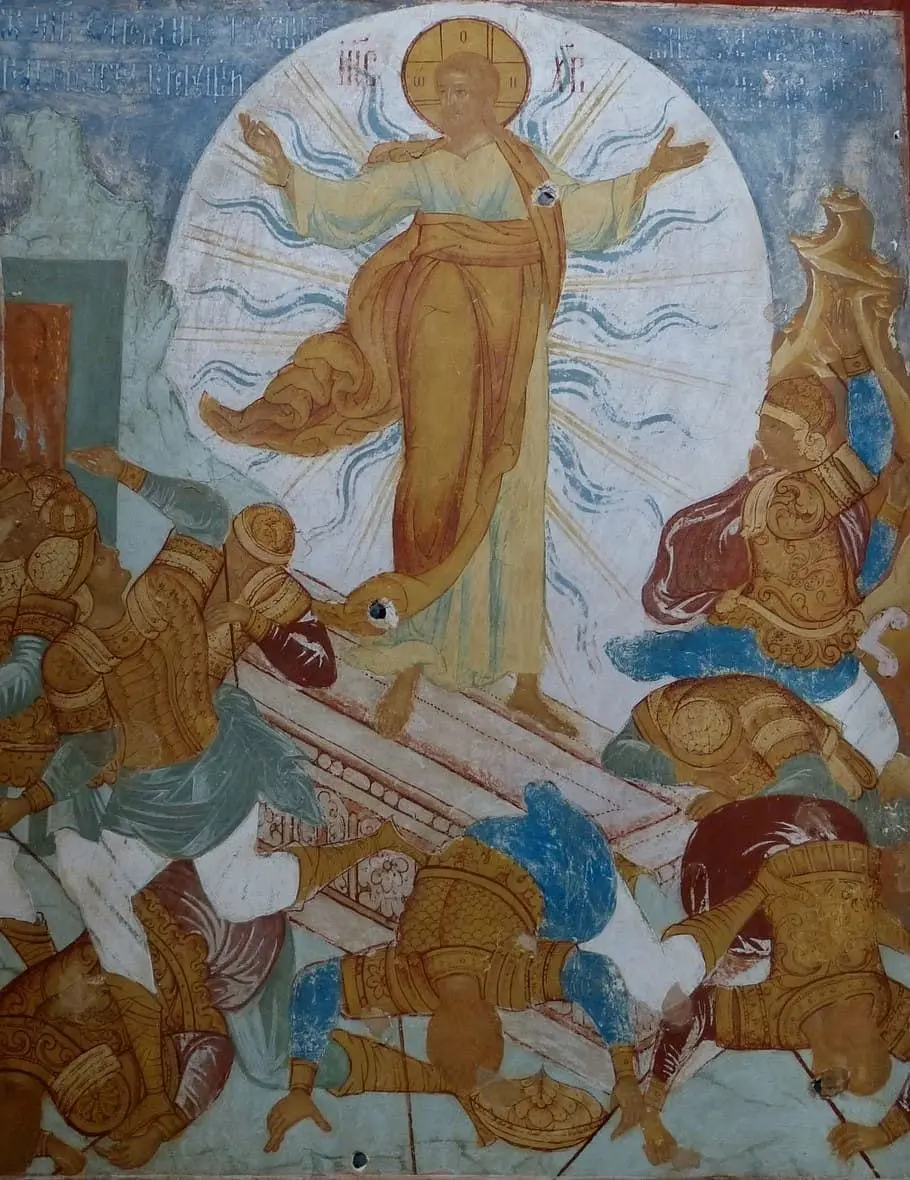
The journey of the soul moves from the initial discipline of Davidic acceptance, through the reorientation of valuation, to the synergistic hosting of the Logos, and finally into the sacramental life of the Church. The ultimate aim of this entire journey is TheosisTheōsisNot that we become God by nature, but that by grace we are drawn into His life: “partakers of the divine nature” (2 Peter 1:4). — the immortalization of man. Yet immortality is not an end in itself; it is ordered toward tabernacling with God (1 Corinthians 15:53–54). The human person must be made immortal to continue in eternal communion with the Ancient of Days. This is the central promise of the Gospel: that death is not the final word, and that Christ, as the firstfruits of them that slept, has paved the way for the resurrection of the dead.
This promise is found exclusively in the name of Jesus Christ. There is no other name under heaven by which man can be saved or attain to the divine nature. Whether one is Greek or Gentile, Caucasian or African, the terms of access into the grace of God remain unchanged: a repentant heart and faith in the one who died and rose again. Salvation is the hope of a life to come — an unending life with God that transcends the limitations of the material world. This hope is what enables the believer to "seek for glory and honour and immortality" (Romans 2:7) through patient continuance in well-doing. The exclusivity of this path is the bedrock of Christian hope; even those of other traditions must ultimately find their salvation in the person of Jesus Christ, for He alone has conquered the grave.
The architecture of a stable and flourishing life is, in the end, built upon seeking the Kingdom of God first. When the soul is properly oriented toward its Creator, the pandemic of mental and spiritual instability is healed by the presence of the Divine Life. The value of our existence is found not in what we possess, but in who possesses us. Let us therefore consolidate our efforts to love the Lord with the entirety of our being — partaking in the Holy Eucharist as a confession of the Incarnation and a pledge of the life to come, following the ancient landmarks, honoring the Bishop and the sacramental order, remaining fruitful until that day when all enemies are put under His feet. In the name of the Father, and of the Son, and of the Holy Spirit — may our souls be knitted to the Lord in the hope of the resurrection and the life everlasting. Amen.