The Struggle Against Spiritual Progress
Enoch B Minisi, DD
Participation and Communion (Pre-Fall Anthropology)
Any rigorous theological inquiry into the nature of man must begin with the axiom that God alone defines human destiny. In the realm of ontology, the creature cannot possess the authority to determine its own end—man did not initiate his own existence. He is the product of Divine Will, created "for God" and "for His pleasure." This is the foundational precept of pre-fall anthropology: human existence is inherently participatory. We were not designed to be autonomous or self-referential agents, but were fashioned to participate in the life of the Holy Trinity. The Image and Likeness of God was not a mere static imprint but a dynamic capacity for intimate communion—an invitation to share in the Divine Light and Life.
The Garden of Eden served as the archetypal site of this divine-human community, a space where the uncorrupted beauty of creation was matched by the direct, unmediated voice of the Creator. In that pristine state, Adam possessed a vision of reality that remains inaccessible to us in our fallen condition; he saw creation as God saw it—untainted and whole. The ontological ground of man's existence was communion itself, a continuous and rhythmic participation in the grace of the Godhead. Man existed for the purpose of knowing his Creator through an intimate, experiential knowledge that transcended mere rational inquiry. Into this order, however, an antagonistic presence intruded. The Serpent, the ancient adversary, sought to negate this participatory reality. Because this enemy cannot originate purpose, he must steal or distort it—and in doing so, he set the stage for a cosmic conflict aimed at the very reason for man's being.
The Mechanism of Alienation: Deception, Betrayal, and the Fall
The Fall of man must be understood not merely as a moral lapse but as a profound ontological betrayal. Grasping this root—betrayal—is essential for spiritual discernment in every age, because the adversary continues to employ the same mechanisms to achieve the same end. The Fall was catalyzed by deception, which in turn produced a fundamental rupture in the divine purpose. Satan's methodeia in the Garden was designed to transform the man of God into an enemy of God through the initiation of treason. This betrayal moved from Eve to Adam, and from Adam toward the Creator, producing a state of existential separation from the source of life.
To see the full weight of what occurred, we must hold in view the contrast between God's initiative and the diabolical opposition. Before the Fall and after it, God's overriding goal remained communion and participation—He initiated purpose and, once that purpose was betrayed, moved immediately toward salvation and restoration. Satan's agenda was its precise inversion at every point: opposition to purpose in creation, separation and alienation in the Fall, and the sustenance of that destruction in every generation that followed. God's aim is life; Satan's is death, understood theologically not as biological cessation but as separation from God.
This foundational reality necessitates a divine intervention. As Adam did not create himself, he is ontologically incapable of saving himself. The Adamic nature, once severed from Divine Life, possesses no internal mechanism for self-restoration. The crisis of the Fall therefore required what we might call a Salvific Pivot—one that only the Creator Himself could provide.
The Salvific Pivot: The Incarnate Logos and the Restoration of the Soul
The Incarnation of the LogosLogosThe eternal Word of God, through whom all things were made, who became flesh and dwelt among us (John 1:1–14). represents the strategic necessity of the ages—the only possible remedy for the Adamic catastrophe. Because man is the creature and not the Creator, the work of salvation must originate from the Creator Himself. There is a profound logic to this: the one who did not create the soul cannot be the one to restore it. The entire economy of the Old Testament—the Law, the Prophets, the establishment of the Aaronic priesthood—served as a pedagogical preparation for the arrival of the Incarnate God. The mission was singular: to restore man to his pristine purpose of communion.
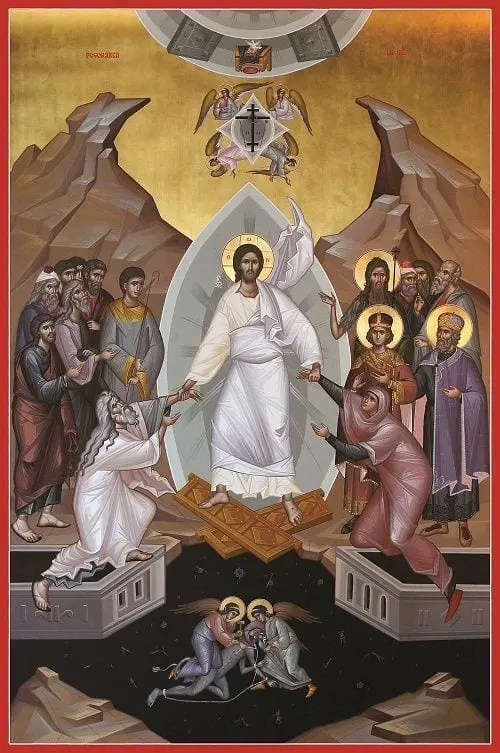
The Passion of the Logos functions as the ontological reversal of the Garden's betrayal. It is a mystery of divine providence that as a betrayal by man caused the death of the race, so the path to the restoration of life began with a betrayal of the Lord by one of His own. Jesus the Christ entered His Passion through the treason of Judas, taking upon Himself the very mechanism of our fall in order to destroy the power of death from within it. Through His death, burial, and resurrection, He fulfilled the mandate of salvation. As He Himself declared: "The thief cometh not, but for to steal, and to kill, and to destroy: I am come that they might have life, and that they might have it more abundantly" (John 10:10, KJV). By His resurrection, the Logos "destroyed him that had the power of death" (Hebrews 2:14, KJV), obtaining a salvation that is not merely a legal reprieve but a transformative restoration of the soul's capacity to participate in the Divine.
The Ecclesia as the Archetypal Garden and Guardian of Doctrine
The Church—the EcclesiaEkklēsiaThe assembly called out by God: the Body of Christ gathered in every place and every age.—is the mystical body established by Christ as the community of the saved and the steward of the divine mysteries. In the spiritual economy, the Church functions as the archetype of the original Garden. In the first Garden, the gates of hell prevailed against man, leading to his expulsion and the loss of the Tree of Life. Yet of the New Testament Church, the Lord declared: "I will build my church; and the gates of hell shall not prevail against it" (Matthew 16:18, KJV). While the first Adam was driven out of the presence of God, the Second Adam draws the regenerated soul back into that presence through the life of the Church.
In this light, doctrine must be understood for what it truly is—not a collection of abstract theories or academic propositions, but the work of spirits. There is no neutrality in the realm of teaching. The Church is the primary battleground between the Doctrine of the Lord and the "doctrines of devils" and "seducing spirits" (1 Timothy 4:1, KJV). The enemy's objective is to introduce what we might call betraying formulations—distortions of doctrine that lead the soul into schismata, the demonic divisions that fracture the unity of the faith. Historically, the Church has served as the defender of the faith, employing instruments such as the Niceno-Constantinopolitan Creed to safeguard the mysteries from internal threat. The emergence of heretics from within the body itself is a recurring stratagem of the adversary, designed to undermine the salvific integrity of the apostolic report.
A Historical Analysis of Schism: From the Nicolaitans to Modern Liberalism
The strategic impact of ecclesiastical division has been the systematic dilution of the fullness of the faith. The enemy's methodeia consistently involves the introduction of a doctrine that opposes the divinely established order—often appearing as something godly or mystical while quietly leading the soul toward ruin.
A primary historical example is found in Acts 6, where "Nicolas a proselyte of Antioch" was chosen as one of the seven deacons, a man regarded at the time as "full of the Holy Ghost and wisdom" (Acts 6:3–5, KJV). Yet this same Nicolas defected, becoming the progenitor of a heretical sect whose deeds and doctrines Jesus explicitly declared He "hated" (Revelation 2:6, 15, KJV). The Nicolaitan heresy promoted a destructive synthesis of Christianity with paganism, immorality, and the corruption of ecclesiastical order. It is the template for what followed.
This pattern of separation has extended across the centuries in what we might term the Great Separation. Around 300 AD, the bishop Arius arose to deny the consubstantiality of the Son with the Father—a doctrine that, if accepted, would have rendered salvation impossible. The Church was compelled to gather in council to defend the deity of Christ and the truth of the Incarnation. In 1054, the Great Schism produced the monumental rupture between the Latin West and the Byzantine East, the first major fracturing of the visible unity that had largely held for a millennium, and it left a West increasingly prone to further fragmentation. The Protestant Reformation followed, as Martin Luther, John Hus, and others departed from Rome. While some sought genuinely to address real abuses, the resulting cascade of schism produced Anglicanism, Lutheranism, Methodism, and ultimately the proliferation of thousands of competing sects. More recently, the rise of Pentecostalism and the contemporary charismatic movements, though often professing great spiritual power, has proven frequently vulnerable to what can only be called Babylonic systems—materialistic gospels and a lack of ontological depth.
We must distinguish, at every point, between having Christians within these various traditions and possessing the fullness of the faith. While individuals may indeed find salvation through the mercy of God, many of the inherited systems of the Western church represent corrupted versions of Christianity—lacking sacramental continuity and the protective wall of apostolic doctrine.
The Methodeia of Satan: Tactical Deception in the Modern West
The term methodeia denotes a highly sophisticated, personalized system of assault—a pathway, a methodos, engineered to ensnare a particular soul. In the modern West, this strategy has evolved most visibly into theological liberalism and the materialistic gospel. This version of faith shifts the center of gravity from participation in God to the betterment of self. Such doctrines function as a cloak for the enemy, leading the soul into spiritual apathy and sloth. When the glorification of self becomes the center of a religious system, it is no longer Christianity—it is a Babylonic system masquerading as the faith.
The world system itself operates as Satan's veil. The adversary gains a decisive tactical advantage by appearing to be absent, concealing himself behind the concrete arrangements of professional life, social status, and cultural decoration. By making himself seem invisible, he encourages the soul to become relaxed and inattentive. This produces what the Lord warned against when He rebuked the Pharisees: the sappa, the whited sepulcher—those who "outwardly appear beautiful," yet are within "full of dead men's bones, and of all uncleanness" (Matthew 23:27, KJV). In the contemporary West, this is precisely the shape of the crisis. We see a form of Christianity obsessed with outward presentation—professional dress, material prosperity, secular approval—while the inward man is consumed by death. This is the ultimate deception of the decoration: the soul is devoured slowly and sweetly because it no longer perceives the presence of the predator.
The Spiritual Armory: Resisting the Personal and Corporate Assault
Against an enemy of such sophisticated cunning, human strength is a proven failure. The strategic imperative is to "be strong in the Lord, and in the power of his might" (Ephesians 6:10, KJV). We contend not with "flesh and blood" but with an organized hierarchy of "principalities, powers, and the rulers of the darkness of this world." The adversary is a masterful organizer. Consider that he successfully drew a third of the celestial host into rebellion—an innumerable company of angels led away by his counsel. Among the powers arrayed against us are beings of terrifying force, such as Abaddon, the prince of the abyss, and those four fallen entities bound at the Euphrates, reserved for the day of judgment.
The nature of authentic spiritual progress is defined by the Greek term pale—wrestling—which implies a grueling, hand-to-hand struggle. There is no spiritual ascension apart from prevailing in this contest against the demonic assignments engineered specifically for each soul's destruction. The Armor of God provides the necessary protection for the precise areas the adversary most aggressively targets. The loins of truth defend against the Father of Lies, who seeks to make the believer a liar and thereby sever his participation in God. The breastplate of righteousness safeguards the heart against the tyranny of the passions. The shield of faith quenches the fiery darts of doubt and doctrinal deviation. The helmet of salvation protects the mind from the Cosmos-Veil and the deceptions of the world system.
No man, in his own wisdom or strength, can withstand the methodeia of the devil. Even the Archangel Michael, when contending for the body of Moses, "durst not bring against him a railing accusation, but said, The Lord rebuke thee" (Jude 1:9, KJV). If the celestial powers rely on the name of the Lord, how much more must we watch and pray, recognizing that our souls are the ultimate prize of this warfare.
The Sacramental Life: The Eucharist and the Mystery of Grace
The treasures of the Church are found in the sacraments—the Holy Mysteries—which are the primary conduits of the grace necessary to endure and prevail in the demonic assault. Chief among these is the Eucharist. In this mystery, our Lord has left us His physical body mystically. There is a profound distinction between what is seen—bread and wine—and what is believed: the real Body and Blood of Christ. This is the Bread of Life that sustains the participatory existence of the believer. To trivialize the Eucharist is to trivialize the very presence of the Logos.
Likewise, Baptism is the essential rite for the attainment of grace and the initiation into the life of the saved. Grace alone is the power capable of reigning over the tyranny of sin. Without an abundance of grace and the gift of righteousness, man is utterly exposed before the enemy. We need only consider Adam to understand this: he was created in pristine wholeness, he saw the glory of God, he heard the divine voice, he beheld creation untainted by sin—and even he betrayed God. If Adam, in that immaculate condition, could not withstand the serpent, how can we—born in sin and surrounded by the sappa of the modern world—hope to stand without the sacramental mysteries? The sacramental life ensures that we rely not on our own strength, but on the enduring power of the Champion of our Salvation.
Conclusion: The Stewardship of the Soul and the Finality of Faith
The failure of the first Adam stands as a perpetual warning to every generation: we must watch over the garden of our souls with unceasing diligence. The deepest tragedy of the modern age is the prioritization of the temporal over the eternal. We dress, feed, and protect the body—a vessel that perishes, grows weary, and returns to dust—while leaving the soul exposed to invisible predators. This is the height of spiritual folly.
We are called to a total rejection of Babylonic systems that offer material gain at the cost of spiritual death. Our calling is one of absolute loyalty to Jesus Christ. The doctrine of salvation is a precious treasure, established by the blood of the Incarnate God, and to treat it with apathy is to blaspheme the sacrifice of the Logos. Let us recommit to the preciousness of that doctrine, for it is the only path back to the communion for which we were created. The ultimate measure of our victory is not found in worldly success or professional stature, but in faithfulness unto the end: "be thou faithful unto death, and I will give thee a crown of life" (Revelation 2:10, KJV). Let us therefore be vigilant—guarding the garden of the soul, and holding fast to the mysteries of the faith—until we behold Him face to face in the unwaning light of His Kingdom.
In the name of the Father, and of the Son, and of the Holy Spirit. Amen.